
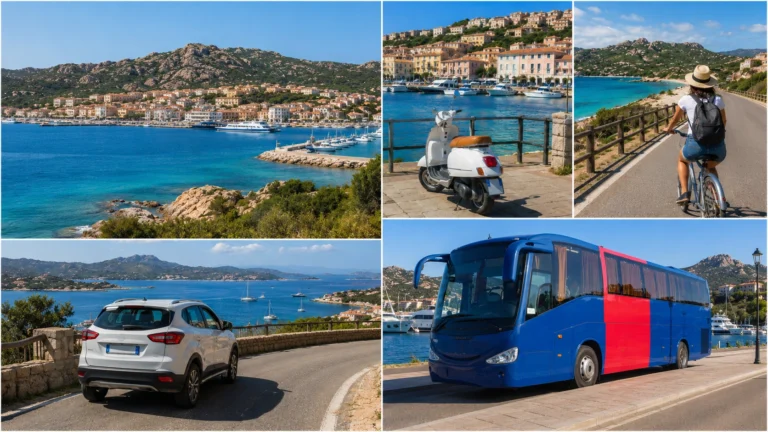
Getting around Palau and La Maddalena: cars, scooters, bikes and buses
Palau is the beating heart of Gallura and the gateway to the La Maddalena Archipelago. Once you arrive, the question naturally arises: what’s the best way to get around and explore this wonderful area? The answer depends on your travel style, the time of year and the destinations you plan to visit. In this comprehensive guide, we look at all the options available for getting around freely and comfortably.
Car hire in Palau: the most flexible option
Hiring a car is undoubtedly the best option for anyone wishing to explore not only Palau, but also the Gallura hinterland, the Costa Smeralda and the more remote beaches. With a car, you have the freedom to stop wherever you like and set your own pace.
Where to hire
In the centre of Palau and the immediate vicinity, you’ll find a number of car hire agencies, including both international brands and local operators. During the high season, it’s essential to book well in advance, as demand is extremely high.
Advantages of car hire
Freedom of movement: you can reach less accessible beaches such as Cala di Trana or the footpaths in Porto Rafael Park.
Convenience when travelling with luggage and equipment: ideal if you’re travelling with your family or bringing beach umbrellas, canoes or diving equipment with you.
Connections to the hinterland: In half an hour you can be in Arzachena or Santa Teresa Gallura for cultural and food-and-wine excursions.
Disadvantages
Car parks: In July and August, finding a parking space in Palau – particularly near the harbour and the seafront – can be difficult. There are paid car parks, but there are also free parking spaces on the outskirts, from where you can walk into the centre.
Excess costsCar hire does cost money, but if the cost is shared amongst several people, it becomes competitive compared with other modes of transport.
Scooter and motorbike hire: manoeuvrability and easy parking
If you love the feel of the wind on your face and want to avoid parking problems, a scooter is the perfect way to get around Palau and the surrounding area.
Why choose a scooter?
Parking is always available: on a scooter, you can find a parking space anywhere, even in the narrow streets of the city centre or near the busiest beaches.
Economy: Hiring a 125 or 150 cc scooter generally costs less than hiring a car, and fuel consumption is very low.
Fun and scenic: Riding a scooter along the coastal road leading to Porto Pollo or Capo d’Orso is a truly unique experience.
What to bear in mind
Protection: it offers no shelter from the sun or rain, so it is particularly recommended in spring and early autumn.
Load capacity: ideal for those travelling light, with a rucksack or a holdall.
Driving licence: A Category B licence is sufficient for 125 cc motorcycles, whilst a Category A licence is required for larger engine capacities.
Where to hire
There are several scooter and motorbike hire agencies operating in Palau, many of which also offer delivery to hotels or the harbour.
Bicycle and e-bike hire: the green and slow option
Palau and its surroundings are ideal for exploring by bike, especially for those who enjoy slow, sustainable tourism. The terrain is hilly, but with a reasonable level of fitness – or with the help of an e-bike – you can tackle some stunning routes.
Recommended cycling routes
Palau seafront: an easy, flat cycle with views of the archipelago, ideal at sunset.
Palau – Porto Pollo: a route of around 15 km through Mediterranean scrubland, offering breathtaking views, with ascents and descents.
Capo d’Orso Loop: a tarmac road but with steep gradients, suitable for experienced cyclists or those on e-bikes.
Benefits of cycling
Zero emissions and silence: perfect for getting out into nature.
Reasonable price: Anyone can hire a traditional bike or an e-bike.
Endless stops: you can stop anywhere to take a photo or have a swim.
Disadvantages
Exhaustion and heat: In the height of summer, cycling during the middle of the day can be tiring. It’s best to set off early in the morning or in the late afternoon.
Limited range: if you want to cycle all the way to Santa Teresa Gallura (about 30 km), you’ll need to gauge your stamina carefully or opt for an e-bike.
Where to hire
There are numerous bike hire companies offering bicycles, mountain bikes and e-bikes in the centre of Palau and at accommodation providers.
Public transport: ARST buses and local services
If you don’t want to drive or hire a vehicle, you can use public transport. The main operator in Sardinia is ARST, which runs the inter-city routes.
Connections to and from Palau
Olbia – Palau: The service runs all year round, with more frequent services in summer. The journey takes about an hour and connects the centre of Olbia with Costa Smeralda Airport.
Palau – Santa Teresa Gallura: another useful route for travelling along the north-east coast.
Internal links: There are no city buses in Palau, as the town centre is small and easy to get around on foot.
Advantages of buses
Cost-effectiveness: Tickets are reasonably priced, making them ideal for travellers on a tight budget.
Sustainability: reduce your environmental impact compared to using a private car.
Disadvantages
Limited frequency: particularly in the low season, there are few services and the timetables do not always fit in with day trips.
Lack of flexibility: you’re tied to timetables and bus stops, and you can’t reach secluded beaches or inland footpaths.
Summer crowds: In July and August, coaches can be full and seats are not always guaranteed.
Practical tip
Download the official ARST app or visit the website to check real-time timetables, which are often subject to seasonal changes.
Heading for the islands: ferries to La Maddalena and the archipelago
A key part of travelling from Palau involves sailing to the La Maddalena Archipelago. The port of Palau is the main point of departure.
Delcomar Ferries: They connect Palau to La Maddalena (the main island) in around 15–20 minutes. There are frequent departures, with more frequent services in summer. You can take cars, motorbikes and bicycles on board, or travel as a pedestrian.
Rubber dinghy trips and boat hire: to reach the smaller islands (Spargi, Budelli, Santa Maria, Razzoli), the most popular option is to hire a boat or day trips organised. In this case, the boat itself serves as your means of transport, and you can travel between the archipelago’s most beautiful coves and beaches.
Tips for getting around the islands
In La Maddalena: Once you’ve disembarked, you can get around in the car you brought on board, or hire a scooter or a bicycle directly on the island. There is also a local bus service, but it’s limited.
Council: If you’re staying in Palau and only going on day trips, leave your car in Palau (in the pay-and-display car parks near the harbour) and travel as a pedestrian on the ferries to save on the cost of the crossing.
Palau: not just a starting point
Remember that Getting to Palau It’s not just the first stop on the way to La Maddalena: this town offers wonderful beaches (such as Porto Pollo Beach and Sciumara), hiking trails with sea views, a lively nightlife and fantastic boat trips. That’s why many travellers choose to stay here for the whole of their holiday.
Final tips for your trip
Book everything in advance: both flights and ferries to the islands, especially if you’re travelling in July and August.
Check the weather and sea conditions: Ferry crossings may be suspended in rough seas.
Make sure you bring comfortable clothing and walking shoes if you’d like to explore the trails in the La Maddalena Archipelago National Park.