
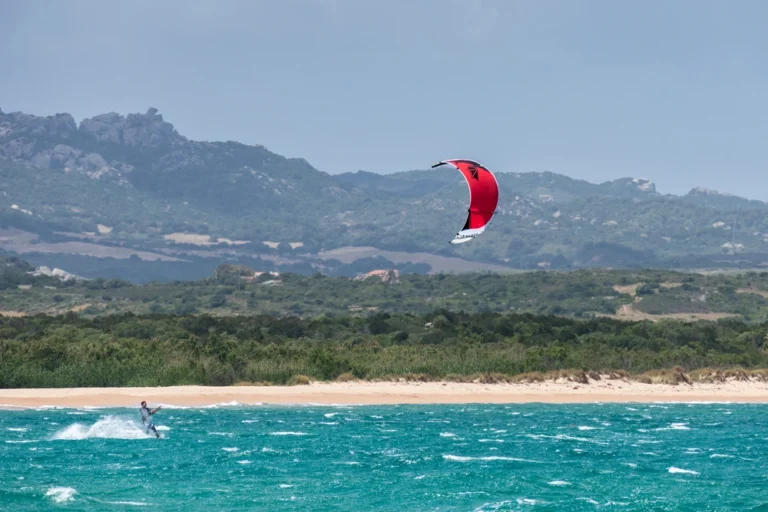
Read this if: You probably thought Palau was just the port for La Maddalena and a couple of quiet beaches. You’ve missed the best bit. Just a stone’s throw from the centre lies one of Europe’s best kitesurfing spots. Consistent wind, crystal-clear water, two bays with contrasting characteristics, and an international community that returns here every summer. This article explains where to go, how it works, which schools to choose, and shares some interesting facts that make this place special. Even if you’ve never kitesurfed in your life.
Where can you go kitesurfing in Palau? There’s only one spot (but it’s legendary)
When it comes to kitesurfing in Palau, we are talking about a specific place: Porto Pollo (in Gallurese Portu Puddu). It is situated halfway between Palau and Santa Teresa Gallura, about a ten-minute drive from the centre of Palau.
Porto Pollo isn’t just any old beach. It’s a isthmus, a narrow strip of sand connecting the mainland to the’Seagull Island (or Isuledda, which in Gallurese literally means “little island”). This means you’re surrounded by water on both sides. And here’s the first brilliant thing: the two bays are completely different.
The two sides of Porto Pollo: West Bay and East Bay
Porto Pollo is divided into two bays separated by an isthmus just a few metres wide.
The West Bay: the home of kitesurfing
This is where it’s done kitesurfing. It is on display at the Mistral, the wind blowing from the north-west. The water is mostly flat or has a slight chop, perfect for learning and for freestyle.
Why is it so perfect for kitesurfing?
The spot is sheltered from crosswinds (onshore/side-shore), so you won’t risk ending up out at sea
The seabed is sandy and shallow for several metres; you can touch the bottom almost everywhere
The water is crystal-clear and warm in summer
Please note: In West Bay, there are strict rules. You usually sail in a clockwise direction, with designated areas for beginners (near the shore) and more experienced sailors (further out to sea). Following these rules isn’t just a matter of courtesy: it’s mandatory to avoid accidents.
The eastern bay: a windsurfing paradise (and also great for kitesurfing when the east wind blows)
The eastern bay has historically been home to the windsurfing. It is more sheltered, with water as calm as a lake, and is exposed to the Levante (easterly wind). When the Mistral isn’t blowing, the Levante sometimes picks up, and that’s when the kitesurfers head over here too.
Fun fact: In the 1990s and 2000s, Porto Pollo was the windsurfing capital of the world. Champions such as Robby Naish e Björn Dunkerbeck. Even today, if you come in September, you can see professional windsurfers putting in some incredible sessions.
Windsurfing isn’t as popular as it used to be, but Porto Pollo still has two distinct sides: the western bay for kitesurfing, and the eastern bay for those who still love gliding along on a sail.
When does the wind blow in Porto Pollo? The kitesurfing season
The good news: there’s plenty of wind in Porto Pollo almost always. It is no coincidence that it is a commercial known throughout Europe.
Kitesurfing season table for Porto Pollo
| Period | Prevailing wind | Intensity | Crowding | Ideal for |
|---|---|---|---|---|
| June | Mistral | 15–25 knots | Medium | Beginners and experts |
| July | Mistral | 18–28 knots | High | Experts (strong wind) |
| August | Mistral / Thermal | 15–22 knots | Very high | Everyone (lighter wind) |
| September | Mistral | 20–30 knots | Medium | Experts (stronger winds) |
| October | Mistral / Sirocco | 15–25 knots | Low | Beginners and experts |
The secret of the venues: the thermal wind
The locals know that in summer, even when the Mistral seems to have died down, the wind often picks up of its own accord around midday as the ground heats up. It’s called thermal wind: the warm air from Galluria rises, the cool sea breeze takes its place, and voilà, you’ve got 12–16 knots – perfect for learning. It lasts until sunset. So don’t give up if it’s calm in the morning: wait until one o’clock.
Fun fact: In Porto Pollo, the wind is so consistent that some professional kitesurfers move there for months at a time. I know people who have sold their homes in Germany to come and live in Palau. The reason? Two hundred days of wind a year.
Where to start? Porto Pollo beach and the inflation areas
La Porto Pollo beach (West Bay) is very well suited to kitesurfers. The launch area is on the sand, with plenty of space to inflate your kite.
What you'll find:
Free parking (but in high season, get there early – around 8.30 am)
Bars and kiosks for your lunch break
Equipment hire (kite, bar, board, harness)
Kitesurfing schools with certified instructors
Shaded areas with awnings where you can leave your rucksack
Please note: Don’t leave your kit unattended. In high season, the beach is full of kit, but thefts are extremely rare. The kitesurfing community is small and everyone knows each other. If you’re new, attach a note with your name to your kite.
Kitesurfing schools in Porto Pollo: where to learn (and which to avoid)
There are several schools and rental centres in Porto Pollo. Some are excellent, others less so. Here’s how to find your way around.
The most renowned schools
| School | Type of courses | Ideal for | Strength |
|---|---|---|---|
| Porto Pollo Kite School | Beginners, intermediate | Everyone | Italian and international instructors, new equipment |
| Isuledda Kite Centre | Advanced, freestyle | Experts | Exclusive spot in the eastern bay for advanced divers |
| Extreme Kite School | Beginners, children | Families | A very educational and patient approach |
What to check before booking a course
Instructor-student ratio: No more than two students per instructor (if they suggest groups of four, look for another school)
Ground-based radio: The instructor talks to you over the radio whilst you’re flying. Without a radio, you’re not learning properly.
Insurance: The school must provide insurance for pupils. Always ask for it.
Prices: A basic course (around 8–10 hours) costs between €400 and €550. If it costs significantly less, something’s not right.
Fun fact: Many of the instructors at Porto Pollo are former windsurfing champions who have turned their passion to kitesurfing. When they explain how to read the wind, they do so with thirty years of experience behind them.
Equipment: should you bring your own or hire it in Porto Pollo?
If you have your own kit and know what you’re doing, bring it along. But do bear the rules in mind.
Bringing your own equipment: what you need to know
The wind is steady, so the right kite sizes are the standard ones: 7–9–12 square metres for most summer days
The seabed is sandy, so you won’t damage your boards (unlike at rocky spots such as Sicily)
The beach is equipped for inflating and storing equipment
Rentals in Porto Pollo
If you're a beginner or don't want to lug around suitcases full of kites, hiring is a great option.
Approximate prices (per day):
| Equipment | Low season | High season |
|---|---|---|
| Kite (complete) + bar | 50-70 € | 70-90 € |
| Table | 15-25 € | 25-35 € |
| Trapeze | 10-15 € | 15-20 € |
| Diving suit | 10-15 € | 15-20 € |
| Complete package (kite + board + harness) | 70-90 € | 90-120 € |
Council: If you’re hiring for several days, ask for a discount. You’ll usually get a 10–15% discount for three days or more.
Levels of experience: who can go kitesurfing in Porto Pollo?
Complete beginners (who have never touched a kite): Perfect. The protected area, the shallow water, the well-organised lessons. In 8–10 hours, you’ll learn how to body drag and water start. You won’t become an expert, but you’ll come out of the water with the basics under your belt.
Intermediate (you can do a water start and sail, but you’re not consistent): Porto Pollo is the perfect place to train. The calm water allows you to focus on your technique. The sidewind gives you confidence. Spend a couple of days here and you’ll go home with much better control.
Experts (you’ve taken your first steps and want to improve): An excellent spot for freestyle and jumps. The flat water is ideal for tricks. But be careful: the Mistral can get strong, exceeding 35 knots. On those days, only the locals go out with small kites (5–6 square metres).
Wave (do you want to surf the waves?): Wrong spot. Porto Pollo has choppy water at best, not waves. For waves, you need to go elsewhere (e.g. Porto Ferro or the Costa dei Venti).
Safety: unwritten (but extremely important) rules in Porto Pollo
In Porto Pollo, there are unwritten rules that the locals enforce strictly. Breaking them means making yourself unpopular (and risking trouble).
Sail clockwise around the western bay. It’s simple: keep the shore on your left. Anyone sailing anti-clockwise is a public hazard.
Avoid walking upwind with the kite when covering long distances. Walk along the beach, don’t fly.
Keep at least ten metres between yourself and another kiter. Crossing paths is the quickest way to get hurt.
If you fall and lose your kite, call for help. Do not try to rescue them yourself if you are in difficulty. Lifeguards and instructors are trained to do so.
Beginners: stay in the area close to the shore. The area further out to sea is for experienced swimmers.
Fun fact: I once saw a bloke sailing the wrong way round. After five minutes, a local instructor approached him and, in a very calm but firm tone, explained the rules to him. The bloke didn’t make the same mistake again. The locals in Porto Pollo are friendly but they don’t tolerate dangerous behaviour.
Where to stay in Palau for kitesurfing? The best places to base yourself
If you’re coming to Palau to go kitesurfing, you won’t want to waste any time. Here’s where to stay, depending on your priorities.
Accommodation guide for kitesurfers
| Area | Advantages | Disadvantages | Ideal for |
|---|---|---|---|
| Palau town centre | Restaurants, amenities, nightlife | A 15-minute drive from Porto Pollo | Anyone who wants to go out in the evening |
| Porto Pollo Campsite | Just a stone's throw from the spot, fully equipped for kitesurfing | Non-existent nightlife | Anyone who wants to make the most of their time in the water |
| Farm stay between Palau and Porto Pollo | Quiet, easy parking | You need to drive to dinner | Couples looking for relaxation and kitesurfing |
| B&B on Isola dei Gabbiani | On the isthmus, with a sea view | Expensive; advance booking required | Those with a large budget |
Camping Porto Pollo: the heart of the kitesurfing community
Camping Porto Pollo is literally right on the beach. Wake up, open your tent, and inflate your kite. In the evening, have a chat with other kitesurfers around a barbecue. The atmosphere is like a hippie village but with all the technical gear. If you love kitesurfing and don’t need luxury, you’ll feel right at home here.
Approximate prices: A tent pitch for two people costs between €30 and €50 per night in high season. Bungalows and mobile homes cost more (€80–€150).
Where to eat in Palau after a day of kitesurfing
If you’ve spent four hours in the water, you’re bound to be hungry. Really hungry. Here’s where to go in Palau to grab a bite to eat.
| Restaurant | Type | Why it works for kitesurfers |
|---|---|---|
| La Focaccia Pizzeria | Pizza | Quick, affordable, and open for lunch too |
| La Preferita | Fish | More expensive, but well worth it after a great session |
| Bread and Oil | Street food | Sandwiches to eat on the beach |
| Harbour bar | Aperitif | For a post-kitesurfing drink with a view of the ferries |
Fun fact: After the strong wind sessions, kitesurfers gather at the bar at the Porto Pollo campsite. No need to introduce yourself: just have a kite under your arm and someone will buy you a beer.
What to bring to Porto Pollo for kitesurfing (checklist)
Technical equipment:
Kite (sizes 7, 9 and 12 square metres, depending on the forecast wind)
The bar and lines are in good condition
Board (table tennis or surfboard, depending on the style)
Harness (make sure the buckles are working properly)
Wetsuit (a 3/2 mm suit is sufficient in summer; a 4/3 mm suit is recommended in spring and autumn)
Helmet (compulsory for some schools, recommended for everyone)
Life jacket (if you're a beginner)
For the beach:
Sun cream (the water-resistant kind)
Water bottle (they sell water at the bar, but it costs more)
Towel and slippers
Quick repair kit for kites (tape, small pump)
Documents:
IKO card (if you have one; otherwise, they’ll issue one for you at the school)
Personal insurance (some schools require it)
How much does a typical day of kitesurfing cost in Porto Pollo?
If you’re starting from scratch, here’s a rough estimate of the cost for a day’s kitesurfing in Porto Pollo.
| Cost item | Approximate cost |
|---|---|
| 3-hour lesson | 100-150 € |
| Full equipment hire | 70-90 € |
| Car park in Porto Pollo | free |
| Lunch at the kiosk | 10-15 € |
| A beer after the session | 5 € |
| Total for the day | 185-260 € |
If you’ve got your own kit and already know how to fly, the costs are minimal: just lunch, a beer and petrol. But the real cost is the addiction. Once you’ve tried Porto Pollo, you’ll be hard-pressed to go anywhere else.
When NOT to go to Porto Pollo (because there’s no wind)
The worst period? May. It seems like a paradox, because May is lovely, but statistically it’s the least windy month in Porto Pollo. Springs in Gallura can sometimes be dead calm.
Other low points:
On days when the sirocco blows (a warm south-easterly wind) – Porto Pollo is sheltered, so it’s almost never windy
Stormy days with mistral winds exceeding 40 knots – even for the pros, that’s too much
The golden rule: Check the wind forecast on Windguru or Windfinder before booking. Look for the “Porto Pollo” or “Palau” station. If you see 15–25 knots, book straight away.
Kitesurfing in Porto Pollo vs other spots in Sardinia
| Feature | Porto Pollo (Palau) | Porto Ferro (Alghero) | La Maddalena (archipelago) |
|---|---|---|---|
| Water | Flat or light chop | Medium to large waves | Mixed (sheltered coves) |
| Wind | A steady mistral | Wavy mistral | Mistral, but less consistent |
| Ideal for | Beginners, freestyle | Wave, experts | Hiking, freeriding |
| Services | Schools, hire, cafés | Almost zero | Limited |
| Crowd | High in summer | Media | Very high (by boat) |
Verdict: If you want to learn or improve your technique in flat water, Porto Pollo is the place to be. If you want waves, head to Porto Ferro. If you want a mix of kitesurfing and picture-postcard scenery, hire a dinghy in La Maddalena.
FAQs on kitesurfing in Palau (because I know you still have some doubts)
Is it suitable for beginners?
Yes, it’s one of the best spots for beginners in Europe thanks to the shallow water, the side winds and the professional schools.
Do you need any certificates?
To hire equipment on your own, some schools require an IKO Level 2 licence or higher. Otherwise, take a refresher course.
Can you go kitesurfing all year round?
From November to March it’s cold (5/4 mm wetsuit) and there are fewer windy days. It’s possible, but not ideal. The real season runs from April to October.
Are there any restrictions?
Yes, at Porto Pollo, kitesurfing is not permitted in the eastern bay if there are windsurfers (due to space constraints). However, when the Levante wind is blowing, the western bay isn’t suitable, so the eastern bay is open to kitesurfers.
Can I come in my campervan?
Yes, there’s a motorhome park near the beach. But it gets full in the high season. Do arrive early.
Is Porto Pollo busy?
It does get busy in July and August. But the spot is so big that you can always find a space to inflate your board and get out there. The only real problem is parking.
Summary: why Palau (and Porto Pollo) are a kitesurfing paradise
Wind: a steady, prevailing Mistral wind, 15–25 knots for most of the summer
Water: flat or slightly choppy, crystal-clear, shallow for metres – ideal for learning
Logistics: top-quality schools, equipment hire, a campsite just a stone's throw away
Atmosphere: international community, welcoming, no posh nonsense
Extras: After your session, you’re just ten minutes from Palau, with its restaurants and nightlife
The only real drawback: In high season, you have to get up early to find a parking space. But it’s worth it, I promise.
One final fun fact: The record for the longest time spent in the water at Porto Pollo is held by a Dutchman who kitesurfed for eleven hours straight. He only stopped because it was dark and he couldn’t see anything anymore. The next day he was back in the water at seven. I don’t know his name, but I know that’s how people are in Porto Pollo: when the wind blows, nothing else matters.
Ready to take flight? Palau is waiting for you. And so is the Mistral.