
Caprera Garibaldi: The House, the Grave and the Secrets of the Island Where the Hero of Two Worlds Lived and Died
Did you know? Caprera is not just a picture-postcard island with turquoise waters. It was the final resting place of Giuseppe Garibaldi, the hero of two worlds, who lived here for 26 years and died here on 2 June 1882. Today, the island of Caprera Garibaldi is a national monument, an open-air museum and one of the most evocative destinations in the La Maddalena Archipelago National Park. In this guide, I’ll tell you everything you need to know to visit Garibaldi’s house, his grave, the secret spots he loved, and how to organise your trip. Read on: by the end, you’ll discover a little-known fact that not even many Sardinians are aware of.
Who was Giuseppe Garibaldi, and why did he choose Caprera of all places?
Giuseppe Garibaldi was not just a general. He was the man who united Italy, the revolutionary who fought in South America and Europe, the folk hero who still fills the pages of history books today. But there is a side to Garibaldi that many are unaware of: he was also a farmer, a livestock breeder, a simple man who loved solitude and the wilderness.
Garibaldi discovered Caprera almost by chance. In 1855, after sailing for a long time through the Maddalena archipelago, he fell in love with this barren, windswept island, inhabited only by goats and Mediterranean scrub. He bought half of it and decided to make it his home. Why Caprera of all places? Because it was isolated, far from the chaos, defensible and beautiful. And because, as he himself wrote in a letter to his wife, “here the air is pure, the water is fresh and the sky is always blue”.
From that moment on, Caprera and Garibaldi became one and the same. The Hero of Two Worlds never left the island again, save for brief periods. Here he received distinguished guests, wrote his memoirs, tended his vegetable garden, bred horses and planned his final campaigns. And it was here, in his beloved Casa Bianca, that he died on 2 June 1882.
Where is the island of Caprera Garibaldi and how do you get there?
The island of Caprera is situated in the heart of the Maddalena archipelago, a few kilometres from the north-eastern coast of Sardinia. It is the second the largest island in the archipelago and is connected to the island of La Maddalena by a 600-metre-long bridge called Passo della Moneta.
To get to Caprera Garibaldi, just follow these three simple steps. First: head to Palau. Palau is the main port for ferries to the archipelago. If you’re coming from Olbia, it’s about a 45-minute drive. If you’re staying on the Costa Smeralda, it’s half an hour.
Second: take a ferry from Palau to La Maddalena. The crossing takes 15 to 20 minutes. Ferries run frequently; in high season, they depart roughly every half hour. You can take your car or bike, or simply walk. Third: once you’ve disembarked at La Maddalena, follow the signs for Caprera. Cross the bridge and in less than five minutes you’ll be on the hero’s island.
A tip from someone who’s been there: if you can, leave your car in La Maddalena and hire a bike or a scooter. On Caprera, there are few car parks near the beaches and the Compendio Garibaldino, and in summer they fill up before 9.30 am.
What to see in Caprera Garibaldi: the Compendio Garibaldino (White House)
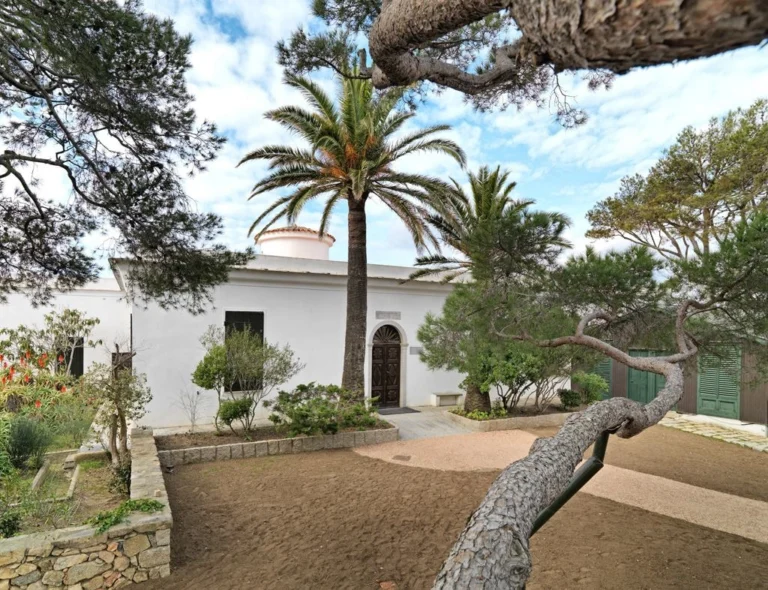
The beating heart of Caprera Garibaldi is the Compendio Garibaldino, also known as the Casa Bianca. It is not just a museum. It is the house where Garibaldi lived for 26 years, where he ate, slept, wrote, planned battles and received heroes and monarchs.
Stepping inside the Casa Bianca is like stepping back in time 150 years. The rooms have remained exactly as Garibaldi left them. You can see his simple bed, his desk and his personal belongings. And then there is the armchair where he died, on 2 June 1882, at 6.21 pm. Next to it, the calendar frozen on that date and the clock showing that time. It’s a moment that takes your breath away. There is no rhetoric, no grandstanding. There is only the stark reality: you are in the room where a man who changed history closed his eyes forever.
The museum also houses artefacts from Garibaldi’s campaigns: uniforms, weapons, flags, autographed letters and gifts received from all over the world. One section is dedicated to Francesca Armosino, his wife who looked after him until the very end, and to their children.
The Compendio is open all year round, but opening hours vary. In summer, it is open from 9.00 am to 7.00 pm; in winter, it closes earlier. Admission costs just a few euros and also includes entry to the Forte Arbuticci Memorial.
Garibaldi’s grave in Caprera: a place of silence and respect
Just a few steps from the White House, hidden amongst the towering eucalyptus trees that Garibaldi himself planted, lies his grave. It is a simple granite slab, without any frills or grand statues. Above it is inscribed only: “Giuseppe Garibaldi – 1807–1882”. Beside him lie Francesca Armosino and some of their children.
The site is surrounded by Mediterranean scrub. There is an almost complete silence, broken only by the wind and the birdsong. It is a place that inspires respect and reflection. Many visitors leave a flower, a stone or simply a thought.
Did you know? Garibaldi had asked to be buried in a simple manner, without any monuments. And so it was. His grave is visited every year by thousands of people, both Italian and foreign, who come to pay their respects to the hero of two worlds.
Why did Garibaldi love Caprera? The hero’s secret spots
Garibaldi didn’t just love his home. He loved the whole island. Every day he would go for long rides on horseback or walks, exploring coves, footpaths and vantage points. Some of these places still bear his name today.
Cala Garibaldi, for example, was one of his favourite beaches. The hero used to swim there often, even in winter. He said that the cold water kept him healthy and strong. Today, Cala Garibaldi is one of the most popular beaches with tourists: fine white sand, shallow waters and crystal-clear water.
Then there is Cala Serena, a secluded and peaceful cove. According to Garibaldi’s diaries, he used to bathe naked here, away from prying eyes. Today, it remains one of the most secluded coves on Caprera.
And then there’s Mount Tejalone, the island’s highest peak (212 metres). Garibaldi often climbed it to gaze out at the horizon. He said that from up there he could see Corsica and dream of freedom. Today you can climb it too, with an hour’s walk, and enjoy the same view.
Beyond Garibaldi: what to do in Caprera once you’ve seen his house and grave
Caprera isn’t just about Garibaldi, even though Garibaldi is everywhere. The island has much more to offer, especially for those who love nature, hiking and military history.
During the Cold War, Caprera was home to a secret NATO base, nicknamed “Little America”. Today you can visit some bunkers and radar stations, such as the Punta Rossa Battery and the Poggio Rasu Battery. Some areas are still off-limits (still NATO property), but those that are accessible are fascinating and rarely visited. If you’re a military history enthusiast, you’ll come away with plenty of photos.
If you love animals, bring a pair of binoculars. The Cala Napoletana area is home to the Corsican seagull, one of the rarest birds in the world (there are only around 150 pairs left). With a little patience and silence, you can see it flying just a few metres away from you. Also there, on the cliffs overlooking the sea, lives the peregrine falcon.
And if you fancy a hike, the Garibaldi Trail links the Compendio to Forte Arbuticci. It’s a walk of about two hours through Mediterranean scrub and maritime pines, with views of the archipelago. Make sure you bring trainers and a bottle of water.
Is there accommodation in Caprera Garibaldi? Where to eat and how to get around
Frequently asked question: can you stay overnight on Caprera? The answer is no. There are no hotels, B&Bs or holiday homes. Camping is strictly prohibited across the whole island. The only exception is the Caprera Sailing Centre, a historic sailing school that offers accommodation only to its students during courses. So, if you’re not enrolled on a sailing course, you’ll have to stay elsewhere.
The best option is to stay on the island of La Maddalena, which is just a few minutes’ drive from the bridge. Alternatively, you can stay in Palau, Santa Teresa Gallura or on the Costa Smeralda. From there, take the ferry every morning and in 20 minutes you’ll be in La Maddalena; then cross the bridge and you’ll be in Caprera.
There are no restaurants on Caprera where you can eat. Bring a packed lunch. The only place to get something to eat is a small kiosk near Cala Garibaldi (open only in high season and with limited opening hours). So: pack a rucksack with sandwiches, fruit, plenty of water and a beach towel.
How to get around? A car is convenient, but there are few parking spaces. In July and August, if you arrive after 10 am, you’ll be driving around for half an hour without finding a space. Better to go by bike or scooter, which you can hire in La Maddalena. Cycling along the scenic road that runs alongside Cala Portese and Punta Rossa is a wonderful experience.
The rules for visiting Caprera Garibaldi without getting fined (and without feeling guilty)
Caprera is part of the La Maddalena Archipelago National Park. And the park has strict rules. Here are the ones you absolutely must follow if you don’t want to ruin your holiday with a hefty fine.
Firstly: it is forbidden to take sand, shells or pebbles. It may seem like a trivial rule, but every summer tourists are stopped with jars of sand or shells in their rucksacks. The fine starts at 500 euros. Don’t do it.
Secondly: do not anchor freely in marine areas. Use only the designated buoys, otherwise you risk damaging Posidonia, a protected marine plant.
Thirdly: camping and lighting fires are prohibited across the whole island. There are no designated camping areas. If you want to sleep under the stars, go somewhere else.
Fourthly: dogs are not permitted on the beaches during the summer season, except in designated areas. Caprera is not a pet-friendly island like others. There are nesting areas for extremely rare birds, and dogs—even when on a lead—stress them out.
Fifth: please keep quiet in nesting areas. Do not shout, play music or use drones. The national park may confiscate your drone and fine you.
It may seem like a lot of rules, but they are the only reason Caprera is still so beautiful. By following them, you’re ensuring that those who come after you will be able to enjoy the same crystal-clear waters and the same places that Garibaldi once did.
Interesting facts about Caprera Garibaldi that you (perhaps) didn’t know
Before I go, I’d like to share three interesting facts about Caprera and Garibaldi that you can tell your friends whilst you’re lying on the beach or standing in front of the hero’s grave.
First interesting fact: Garibaldi personally planted the eucalyptus trees around his grave. He believed that their scent would repel mosquitoes and prevent malaria. At the time, malaria was a serious problem in Sardinia, and Garibaldi was convinced that eucalyptus trees were a natural solution. Today, those trees stand tens of metres tall and create an almost mystical atmosphere.
Here’s another interesting fact: Garibaldi wasn’t rich. In fact, he always lived on very little money. The White House is furnished in a spartan, almost austere style. He cultivated the vegetable garden himself and kept goats and horses to make ends meet. When he died, he left very few material possessions. But he left an immense moral legacy.
Third interesting fact: the Passo della Moneta, the bridge linking Maddalena and Caprera, was not built in Garibaldi’s day. The hero travelled between the two islands by boat. The bridge was only built in 1958, almost 80 years after his death. Garibaldi never saw it. But today, crossing it knowing that you are following in his footsteps is a moving experience.
When to visit Caprera Garibaldi: the best time of year
When is the best time to visit Caprera to see Garibaldi’s sites? The best months are May, June, September and October. During these months, the weather is warm but not sweltering, the sea is suitable for swimming from mid-May until the end of October, and, above all, there are no crowds. The ferries aren’t full, you can find parking spaces, and there are no endless queues at the Compendio Garibaldino.
July and August are lovely, of course. But you need to know what to expect: queues for the ferry from Palau, nowhere to park, queues at the entrance to the Casa Bianca, and the need to book everything weeks in advance. If you have a choice, avoid the first half of August. If you don’t, be prepared to wake up at 7.30 am and be at the Compendio by 9.00 am, as soon as it opens.
Another tip: the wind. Caprera is exposed to the mistral and the libeccio. If you see a red flag at the harbour, it means rough seas and many beaches will be dangerous or closed. On those days, spend your time visiting the Compendio Garibaldino, the bunkers and the inland trails. Caprera isn’t just about the sea, as I’ve told you.
The perfect day trip to Caprera Garibaldi
If you’re looking for some practical advice, here’s the itinerary I recommend to anyone who asks me how to spend a perfect day on Caprera, taking in history, nature and the sea.
Wake up at 7.30 am, ferry from Palau to La Maddalena at 8.30 am. Get off, cross the bridge and you’ll be in Caprera by 9.00 am. First stop: Compendio Garibaldino. You arrive early, there’s no queue, and you can take your time visiting the house and the tomb in an hour and a half.
At 10.30 am, head towards Cala Garibaldi. There’s plenty of parking, and you can get straight into the water. Take your first swim of the day right on the beach that the hero loved.
A packed lunch on the beach or on a viewpoint.
In the early afternoon, we walked to Cala Serena. A half-hour walk along a path through the Mediterranean scrub. Our second swim, in a more secluded and peaceful cove.
At around 3.30 pm, the climb up to Monte Tejalone. The highest peak on Caprera, 212 metres. It’s not an impossible climb, but the view over the entire Maddalena archipelago makes every drop of sweat worthwhile. From up there, just as Garibaldi did, you gaze out towards Corsica and breathe deeply.
We head back down to La Maddalena at around 5.30 pm. Dinner in the harbour at La Maddalena – fresh fish, perhaps a plate of spaghetti with clams. Then the ferry back to Palau. A perfect day.
Conclusion: Caprera Garibaldi awaits you, but with respect
Caprera is not an island like any other. It is Garibaldi’s island. It is the place where the hero of two worlds chose to be reborn, as a free man, and where he chose to die. Visiting his home, walking where he walked, swimming in the very waters he swam in is an experience that goes beyond mere tourism. It is a secular pilgrimage, a journey through the history of Italy.
But Caprera is also a protected area, part of the La Maddalena Archipelago National Park. Visiting it is a privilege, not a right. Please respect the rules: do not take sand, do not leave rubbish behind, and do not make noise where birds are nesting. Only in this way will Caprera remain the jewel it is today, and the memory of Garibaldi will live on.
And if you do, you’ll take home something far more beautiful than a seashell or a selfie: you’ll take home a piece of history, a genuine memory, made of granite, Mediterranean scrub and that freedom which Garibaldi loved above all else.
Enjoy your trip to Caprera with Garibaldi.