
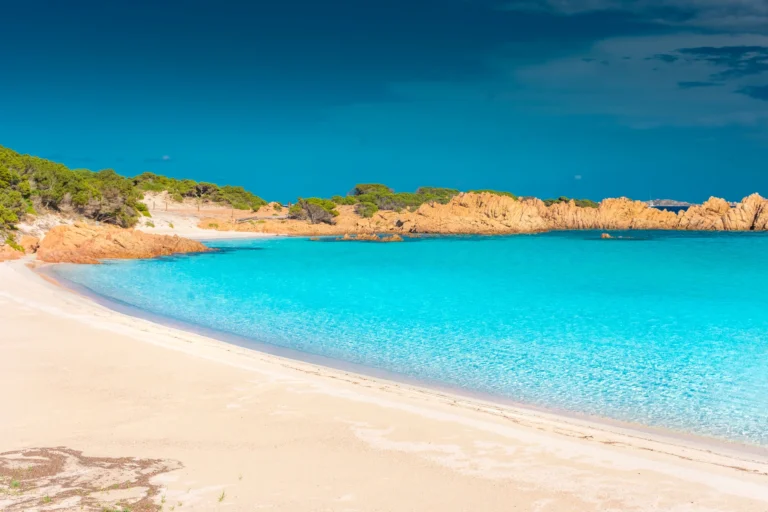
The Island of Budelli is one of the five main islands of the La Maddalena Archipelago, located in the La Maddalena Archipelago National Park in northern Sardinia, province of Sassari, Gallura. Its name is inextricably linked to a unique geological and biological phenomenon: the Pink Beach, whose colour derives from the shells of a marine protozoan called Miniacina miniacea, a benthic foraminifera belonging to the order Rotaliida.
However, since 2020, access to the island has been completely forbidden. It is no longer possible to walk on the Pink Beach, let alone pick up sand fragments. This guide explains exactly why, what the penalties are under the National Park regulations, and how you can admire Budelli and its pink beach during a boat trip from Palau.
1. Geographical context: Budelli in the Maddalena Archipelago ecosystem
The island of Budelli lies in the heart of the La Maddalena Archipelago National Park, established in 1994 by decree of the President of the Republic. The National Park covers an area of more than 15,000 hectares of sea and about 5,000 hectares of land, including 60 islands, islets and rocks.
Geographical coordinates of Budelli:
Latitude: 41°17′ N
Longitude: 9°21′ E
Distance from the Sardinian coast: approximately 2.5 kilometres
Distance from the island of La Maddalena: about 1.8 kilometres
Distance from the port of Palau: approximately 8 kilometres
Sailing time from Palau by pleasure boat: 30-40 minutes
Morphological and geological features of Budelli:
| Parameter | Detail | |
|---|---|---|
| Surface area | 1.6 square kilometres (approximately 160 hectares) | |
| Coastal perimeter | 12.1 kilometres | |
| Maximum altitude | Monte Budello, 57 metres above sea level | |
| Dominant geology | Hercynian granite | Metamorphic rocks |
| Costa | Indented, with inlets and coves | |
| Coastal ecosystems | Posidonia oceanica meadows | Backdune wetlands |
| Protection status | Integral protection zone (Zone A) of the National Park |
Budelli belongs to the so-called “Bocche di Bonifacio System”, a stretch of sea between northern Sardinia and southern Corsica, recognised as a Site of Community Interest (SCI) and Special Protection Area (SPA) for marine birds.
2. Budelli's Pink Beach: a unique sedimentological phenomenon
The Pink Beach of Budelli (Sardinian: Spiaggia Rusata) is a sedimentary formation of worldwide scientific significance. It is not the only pink beach on the planet, but it is considered the most spectacular for its chromatic intensity and purity of colour.
Extent and physical characteristics
The Spiaggia Rosa (Pink Beach) is located on the west coast of Budelli, exposed to the mistral and south-westerly winds. It is about 180 metres long and varies in width between 15 and 30 metres, depending on the tides and seasons.
The sand of the Pink Beach is composed of a granular mixture of:
Quartz and feldspar (from the fragmentation of Hercynian granite)
Shell fragments of marine molluscs (bivalves and gastropods)
Shells of benthic foraminifera
Calcareous sponges
The pink colouration is not uniform on the beach. It is mainly concentrated in the foreshore (tidal zone), where wave action selectively accumulates the lighter fragments of Miniacina miniacea.
Pink spectrophotometry
Scientific studies conducted by the University of Sassari, Department of Nature and Territorial Sciences, have measured the colour coordinates of the sand of the Pink Beach in the CIE L colour space*a*b*:
| Colour parameter | Average value |
|---|---|
| L* (brightness) | 65-72 |
| a* (red-green component) | +12 a +18 |
| b* (yellow-blue component) | +8 a +14 |
By comparison, a white sand typical of northern Sardinia has a* values between 0 and +2. The figure of +12/+18 confirms the exceptional intensity of the pink pigment.
3. Miniacina miniacea: the foraminifera that colours the sand
The culprit is Miniacina miniacea (Pallas, 1766), a planktonic and benthic foraminifera belonging to the class Globothalamea, order Rotaliida, family Rosalinidae.
Taxonomy and biology of the foraminifera
| Taxonomic level | Scientific name |
|---|---|
| Domain | Eukaryota |
| Kingdom | Chromist |
| Phylum | Retaria |
| Subphylum | Foraminifera |
| Class | Globothalamea |
| Order | Rotaliida |
| Family | Rosalinidae |
| Genre | Miniacin |
| Species | Miniacin miniacea |
Miniacina miniacea is a single-celled organism that secretes a calcareous shell (head) that is red or dark pink in colour. The shell has a complex structure, perforated by pores that allow the extension of pseudopods for locomotion and feeding.
Ecology and habitat
Miniacina miniacea lives exclusively in oligotrophic (nutrient-poor) and well-oxygenated waters, typical of the western Mediterranean. It prefers:
Depths between 5 and 50 metres
Water temperature between 15°C and 25°C
Salinity around 38 per mille
Hard substrates (rock) or Posidonia oceanica meadows
The organism attaches itself to the substrate by means of a calcareous stalk. It mainly colonises the leaves of Posidonia oceanica, which in the Budelli area form prairies extending over more than 200 hectares.
Reproductive cycle and sedimentation
Miniacina miniacea has a life cycle of about 6-8 months. After death, the calcareous shell detaches from the substrate and is transported by sea currents towards the shoreline.
The formation time of pink sand is extremely slow:
Annual production of new shells: estimated to be 0.3-0.5 mm thick on the beach
Time needed to form 1 centimetre of pink sand: 20-30 years
Estimated age of the present Pink Beach: about 8,000 years (after the last ice age)
4. Why you can no longer walk on the Pink Beach: chronology of prohibitions
The ban on access to Budelli's Pink Beach is not a recent development. It has a history of more than 25 years, made up of ordinances, seizures and progressive restrictions.
Regulatory and administrative history
| Year | Event | Effect |
|---|---|---|
| 1994 | Establishment of the La Maddalena Archipelago National Park | Budelli falls under zone A (integral protection) |
| 1998 | First order prohibiting landings in Budelli | No going ashore, but weak controls |
| 2000 | Ministry of the Environment Decree | Reinforcing the ban on access to the Pink Beach |
| 2011 | Budelli auctioned to New Zealand entrepreneur | Island purchased for 2.94 million euro |
| 2013 | Media exposure of the degradation of the Pink Beach | Allegations of illegal sand harvesting |
| 2016 | Seizure of the island by the Tempio Pausania Public Prosecutor's Office | For violation of landscape legislation |
| 2017 | Renationalisation of Budelli | Italian state buys back the island for EUR 3.5 million |
| 2020 | National Park Final Regulations | Absolute ban on landings throughout Budelli |
| 2023 | Installation of barriers and video surveillance systems | Continuous monitoring of the Pink Beach |
The problem of sand theft
Between 2000 and 2015, it is estimated that over 500 kilograms of sand per year were illegally removed from Budelli's Spiaggia Rosa. Miniacina miniacea fragments were found for sale on e-commerce platforms such as eBay and subito.it, at prices between 50 and 200 euros per bottle.
The penalties for taking sand from the Pink Beach are:
Administrative fine of between EUR 500 and EUR 3,000
Criminal prosecution for aggravated theft (if the quantity exceeds 5 kg)
Seizure of the vehicle used (boat, car)
In 2024, the National Park intensified its controls with drones and thermal cameras on board the patrol boats of the La Maddalena Harbour Office - Coast Guard.
5. The 2017 Seizure and Renationalisation of Budelli
A key chapter in Budelli's recent history is the renationalisation in 2017. The island had been bought at auction in 2011 by New Zealand businessman Michael Harte for EUR 2.94 million. Harte had stated that he wanted to protect the island, but his management was challenged for unauthorised building interventions.
On 28 November 2016, the Tempio Pausania Public Prosecutor's Office ordered the preventive seizure of the entire island of Budelli, contesting:
Unauthorised construction work (fences, small structures)
Violation of National Park regulations
Damage to the landscape asset
After a year of negotiations, on 14 December 2017, the Italian state bought back Budelli for EUR 3.5 million, with funds from the Ministry for the Environment and Protection of Land and Sea. The island was handed over for management to the La Maddalena Archipelago National Park.
As of 2018, Budelli is officially the unavailable heritage of the Italian State, with an exclusively naturalistic and scientific use.
6. Budelli today: integral protection zone and current bans
Today, Budelli is classified as Zone A (integral protection) of the La Maddalena Archipelago National Park. This classification entails the highest level of environmental protection.
Absolute prohibitions in force in Budelli
| Prohibition | Detail | Sanction |
|---|---|---|
| Landing | You cannot go ashore anywhere on the island | 500-2,000 euro |
| Bathing on shore | You cannot approach within 50 metres of the shoreline | 250-1,000 euro |
| Anchoring | Anchoring prohibited in the area in front of the Pink Beach | 500-1,500 euro |
| Fishing | Totally forbidden in the entire perimeter of the island | 1,000-4,000 euro |
| Collection of sand, shells or minerals | Any withdrawal is an offence | 500-3,000 euro + criminal complaint |
| Drone overflight | Prohibited below 300 metres | 1,000-2,500 euro |
Activities permitted within the perimeter of Budelli
The only permitted activities are:
Transit navigation more than 100 metres from the coast
Sighting the Pink Beach from the sea, without interrupting navigation
Scientific research activities authorised by the National Park
Environmental monitoring by supervisory bodies
Pleasure and excursion boats, such as those of Petagus, must maintain a safe distance of at least 100 metres from the Budelli coastline and may not interrupt navigation for more than 10 consecutive minutes in the stretch of water in front of Spiaggia Rosa.
7. Semantic comparison: Budelli vs Spargi vs Santa Maria vs Caprera vs Razzoli
To fully understand the uniqueness of Budelli in the context of the Maddalena Archipelago, here is a comparative table that includes all the main islands of the archipelago.
| Parameter | Budelli | Spargi | Santa Maria | Caprera | Razzoli |
|---|---|---|---|---|---|
| Surface area (km²) | 1,6 | 4,2 | 2,0 | 15,7 | 1,5 |
| Landing permitted | No (Zone A) | Yes (Zone B) | Yes (Zone B) | Yes (Zone B-C) | No (Zone A) |
| Pink Beach | Yes (famous) | No | No | No | No |
| Miniacin Foraminifera | Very high density | Low | Absent | Absent | Media |
| Posidonia meadows | Extensive (200 ha) | Extended | Moderate | Limited | Extended |
| Stable human presence | No | No | No | Yes (museums, trails) | No |
| Day-trip visibility | Only from aboard | Parking on the ground | Parking on the ground | Overland excursion | Only from aboard |
| Unique sedimentological phenomenon | Yes (pink sand) | No | No | No | No |
Key difference to Spargi: Spargi, although protected, allows landing on Spiaggia del Cavaliere and Cala Corsara. Budelli, together with Razzoli, is the only major island in the archipelago with a total ban on land access.
8. Seeing Budelli during the boat trip with Petagus
Despite the ban on disembarkation, Budelli and the Spiaggia Rosa (Pink Beach) are included in the sailing itinerary of the Petagus excursions departing from the tourist port of Palau.
Operational description of parking in Budelli
In the standard 7-hour itinerary, the sighting stop in Budelli typically occurs after a visit to Spargi or the Piscine Naturali.
| Phase | Detail |
|---|---|
| Approach | The boat is positioned 150-200 metres off the west coast of Budelli |
| Length of stay | 15-20 minutes (timed to comply with regulations) |
| Mode | Diving stop not permitted. Observation from the bridge only |
| Distance to Pink Beach | Approx. 180-220 metres, optimum visibility with binoculars |
| What you can see | The pink band of the beach, the contrast with the green of the Mediterranean maquis and the blue of the sea |
During this stop, the crew of Petagus provides a scientific explanation of the phenomenon of the foraminifera Miniacina miniacea and the history of Budelli's renationalisation.
Why no diving stop in Budelli
Unlike the Natural Pools or Spargi, swimming or diving is not allowed in Budelli. The reasons are:
Bathing on shore is considered a form of disturbance to fish fauna and the coastal ecosystem
Even swimming at a safe distance can alter the sedimentation of pink sand
The currents in the Budelli area are strong and dangerous for navigation
9. Frequently asked questions on Budelli, Spiaggia Rosa and foraminifera
What exactly is the organism that makes Budelli's sand pink?
Miniacina miniacea, a foraminifera of the class Globothalamea. It is a unicellular marine protozoan with a red or dark pink calcareous shell.
Can you still see the Pink Beach up close?
Yes, by boat, keeping a distance of at least 100-150 metres from the coast. It is not possible to go ashore or approach by swimming.
What is the fine for taking sand from the Pink Beach?
500 to 3,000 euro administrative penalty, plus possible criminal charges for aggravated theft. In 2023, 12 fines were imposed for sand removal in Budelli.
Are Budelli and Spargi the same thing?
No. Budelli is smaller (1.6 km² vs. 4.2 km²), has a complete ban on landings (Spargi allows landings) and is the only one with Pink Beach and foraminifera Miniacina miniacea.
Since when is it forbidden to go ashore in Budelli?
The absolute ban on landings has been in force since 2020, but partial restrictions had already existed since 1998. The renationalisation in 2017 led to the final tightening.
Who owns the island of Budelli today?
The Italian state, which bought it back in 2017 for EUR 3.5 million. The island is managed by the La Maddalena Archipelago National Park.
How long does it take to form 1 kg of pink sand?
Approximately 15-20 years. The annual production of new Miniacina miniacea shells is estimated at 50-70 grams per square metre of Posidonia oceanica meadow.
Can you see live foraminifera?
Yes, but only with high-magnification snorkelling equipment (underwater magnifying glass). They are visible as small pink dots attached to the leaves of Posidonia oceanica.
Why is Budelli so famous if you can't go down there?
Precisely for the Pink Beach, one of the rarest sedimentological and biological phenomena in the Mediterranean. The ban on access has increased its aura of exclusivity and desirability.
What is the difference between Budelli and the Pink Beach on the island of Formentera?
The Pink Beach in Budelli is of biological origin (foraminifera Miniacina miniacea), while that of Ses Illetes in Formentera (Balearic Islands) is of mineral origin (pink granite fragments). They are two completely different phenomena.
10. Why book with Petagus to spot Budelli
Petagus organises daily departures from Palau with an itinerary that includes sighting Budelli's Pink Beach from a boat. Here are the specific advantages of visiting Budelli.
| Petagus advantage | Why it is useful for Budelli |
|---|---|
| Knowledge of permitted distances | The captain positions the boat exactly at the 150 metre limit, maximum visibility without violating the bans |
| Optimal transit times | The light for photographing the Pink Beach is best between 13:00 and 15:00 (high sun). Petagus schedules passage in that band |
| Scientific explanation on board | The crew illustrates the biology of Miniacina miniacea and the sedimentology of pink sand |
| Binoculars on board | Available to observe details of the beach without getting closer |
| Respect of stop times | The sighting stop lasts exactly 15-20 minutes, as allowed by the National Park regulations |
| Free cancellation within 24 hours | If weather conditions prevent navigation to Budelli (mistral or strong south-westerly winds), it can be rescheduled at no cost |
The complete Petagus itinerary includes:
Stop with disembarkation at Spargi (Knight's Beach)
Diving stop at the Natural Pools
Sighting the Pink Beach of Budelli from a boat
Stop with disembarkation in Santa Maria (Cala Santa Maria)
Panoramic navigation among the smaller islets of the archipelago