
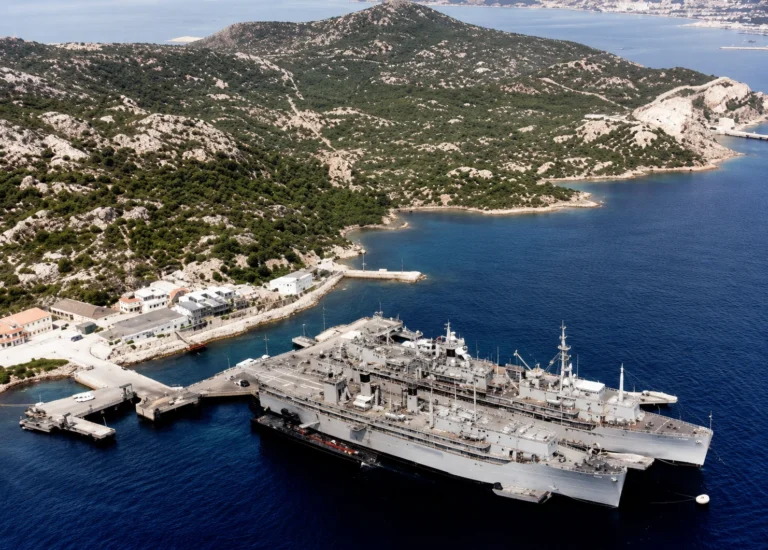
NATO’s Santo Stefano base: the secret history of the bunkers in the Maddalena Archipelago
Did you know that just a few kilometres from the idyllic beaches of the Maddalena Archipelago lies a fully militarised island, full of abandoned bunkers, missile silos and tales of Cold War spies? That island is called Santo Stefano, and for decades it was one of NATO’s most secret bases in the Mediterranean. Today you can see it on boat tours, but few people know what really lies hidden behind those granite rocks.
In this article, you will discover:
Why did NATO choose Santo Stefano, and what was it doing there?
The secret names of the base: “Little Italy” and “Base Athena”
Can you visit them today, and what are the risks of going inside the bunkers?
The difference between the Santo Stefano base and the Caprera base (“Little America”)
Facts that even the locals don’t know
Reading time: 7 minutes. By the end, you’ll know exactly what those bunkers you can see from the sea are, and whether it’s worth (legally) getting closer to them.
Why did NATO choose Santo Stefano of all places? The strategic location you wouldn’t expect
The short answer: Santo Stefano is situated exactly at the narrowest point of the Strait of Bonifacio, the channel separating Sardinia from Corsica. During the Cold War, this stretch of sea, just eleven kilometres wide, was considered a strategic “bottleneck” for control of the western Mediterranean.
The long answer. It is the 1950s. The world is divided into two blocs: the United States and its NATO allies on one side, and the Soviet Union and the Warsaw Pact on the other. The Mediterranean is a crucial theatre: it is the passageway for Middle Eastern oil, for trade routes, and for military fleets. The Strait of Bonifacio, in particular, is a mandatory point of passage for any ship wishing to travel from the Tyrrhenian Sea to the Sardinian Sea.
NATO was looking for forward bases to monitor the movements of Soviet submarines. They needed locations that were hidden, easily defensible, close to shipping lanes, but out of sight of civilians. The Maddalena Archipelago was perfect: a labyrinth of islands and islets, granite cliffs rising steeply from the sea, and an enviable geographical position.
Of all the islands in the archipelago, Santo Stefano had an added advantage. It is almost entirely surrounded by sheer cliffs, with a single, easily defensible access point by land. Furthermore, it had already been used for military purposes in the past: first by Napoleon’s forces, then by the Italian Navy. In short, the ideal place to build something that was not meant to be seen.
A little-known fact: Even before NATO, there was already a small Italian Navy base on Santo Stefano. When the Americans arrived, they expanded it and turned it into a huge facility, with hundreds of military personnel, radar systems, and even a small jetty for mooring military vessels.
What was hidden in the bunkers at Santo Stefano during the Cold War?
That’s the question everyone asks when they see those grey structures jutting out of the granite. The answer is a bit complicated.
The Santo Stefano base, officially known as “Base Athena” (named after the NATO operation that funded it), was not an offensive base. There were no nuclear missiles pointed towards the East. Its function was primarily one of surveillance and eavesdropping.
Inside the bunkers, hewn directly out of the granite rock, there were:
Maritime surveillance radar, capable of tracking any ship or submarine in the Strait of Bonifacio
Communications monitoring stations (SIGINT), to intercept radio transmissions from Warsaw Pact countries
A coordination centre for NATO exercises in the western Mediterranean
Ammunition and fuel depots (protected by thick reinforced concrete walls)
Accommodation for military personnel (up to two hundred people, including Americans and Italians)
There was also a small infirmary, a canteen, and even a cinema for the stationed soldiers. The base was virtually self-sufficient: it had its own electricity generators, a water desalination plant, and food supplies to last for months.
The little-known fact: The American soldiers stationed at Santo Stefano jokingly called the island “The Rock”, in a clear reference to Alcatraz. They felt like prisoners, cut off from the world, with their only link to the mainland being the weekly ferry that brought supplies and post. There were no women, no bars, no holidays. Just bunkers, radar and the sound of the wind.
What are the code names for the base? Little Italy, Base Athena and other code names
The Santo Stefano base has had at least three official names and several informal nicknames. Here is the story.
The NATO technical designation was “Naval Support Activity Santo Stefano”. But in internal US documents, it was often referred to as “Athena Base”, named after the project that funded its construction between 1956 and 1958.
Among the Italian military, however, she was known as “Base Perla” o “Granite Base” (the name varied depending on the department). But the most famous nickname, the one still used by local fishermen today, is “Little Italy”. Yes, just like the New York neighbourhood. Why? Because the base was run by American personnel but had a high proportion of Italian-American servicemen, the children of immigrants who spoke a mixture of English and Southern Italian dialects.
A curious anecdote: It is said that during exercises, radio communications between Italian-American soldiers were incomprehensible to both “pure” Americans and Italians. They used a slang made up of English, Neapolitan and Sicilian. The Soviets, who were intercepting the transmissions, thought it was a coded message. In reality, it was just a conversation about where to go fishing at the weekend.
Following the closure of the base (which took place officially in 2008, though in practice as early as the 1990s), the island was returned to the Italian Navy. Today, there are no longer any military personnel permanently stationed there, but the area is still subject to military restrictions. Some bunkers have been sealed off, others have collapsed, and still others are technically accessible (though illegally).
What remains of the Santo Stefano bunkers today? A journey through ruins and restricted areas
Today, if you take a boat trip from Palau or La Maddalena, you’ll sail around Santo Stefano. And you’ll see them. It’s impossible not to. Grey, boxy structures rising out of the Mediterranean scrub, overlooking the sea from a sheer cliff. They are the remains of the NATO base.
What exactly can you see from the sea:
The large bunker halfway up the hillside. It is the most prominent. A rectangular structure, almost entirely carved out of the rock, with narrow slits and a reinforced door that is still locked. It was the command centre and the radar rooms.
The silos at the top of the island. They look like small concrete domes. They weren’t missiles: they were supports for radio and radar antennas. Some are still intact, others have collapsed.
The quays and bunkering points. On the south-west coast, there are the remains of a small military harbour, with mooring rings still set into the rock. It was the only supply point by sea.
The former powder magazine. An isolated structure, set apart from the rest, surrounded by a double concrete wall. It used to be the ammunition depot. Today, it is the only building that is still officially off-limits (signs reading “military area – no entry”).
Can you visit the Santo Stefano base? The answer is: officially no, technically yes, but not recommended.
Access by land is only possible with a special permit from the Italian Navy. Permits are rarely issued, almost exclusively to historical researchers or journalists. Ordinary tourists are not allowed to set foot on the island, except at certain specific points (such as Cala Granara beach, which is public). However, the bunker area is fenced off and under video surveillance.
What are the risks for those who enter the country illegally? If you venture into the bunkers without permission, you risk being reported for trespassing on military property. The fine ranges from €150 to over €1,000, plus criminal charges if you damage the structures. Furthermore, many bunkers are in a state of disrepair: pieces of concrete fall from the walls, there are holes in the ground, and some contain asbestos. It is not a place for amateur explorers.
A legal alternative: You can visit the bunkers on Caprera, which are freely accessible and very similar. On Caprera, the former NATO posts at Punta Rossa and Poggio Rasu are open to everyone, with no fences or restrictions. They aren’t as impressive as those on Santo Stefano, but at least you can go inside without risking a fine.
Santo Stefano base vs Caprera base: what’s the difference?
Many people confuse the two bases. In reality, they are very different. Here is a clear comparison.
Boxing Day (Athena Base / Little Italy):
Main function: maritime surveillance and communications interception
Size: large (over two hundred soldiers)
Period of operation: 1956–2008 (officially)
Access today: prohibited (military area active only in name)
Condition of the structures: reasonably well preserved; some bunkers are still intact
Caprera (Little America Base):
Main function: NATO logistics and communications support
Size: smaller (around fifty soldiers)
Active period: approximately 1960–1994
Access today: free (part of the La Maddalena Archipelago National Park)
Condition of the buildings: derelict, partially collapsed, but accessible without a permit
The key difference is that the Caprera base consisted of an antenna and a radio station, whereas the Santo Stefano base was a command and control centre. Santo Stefano was the “brain”, Caprera was the “ear”. That is why Santo Stefano is more heavily fortified and more secretive.
A technical detail: The two bases were connected by an undersea cable. Yes, there was a military telephone cable laid on the seabed between the two islands, which ensured secure, tap-proof communications. The remains of that cable are still visible in some places along the coast, if you know where to look.
Can you visit Santo Stefano today? Everything you need to know (and what you risk)
The question every tourist asks when they see the island from the boat. Here’s the full answer.
Areas open to the public: Just Cala Granara, the most beautiful beach in Santo Stefano, and the paths leading to Cala Granara. This area is open to the public; it forms part of the La Maddalena Archipelago National Park, and you can visit it without any trouble. You can get there on a boat tour or by hiring a dinghy.
Restricted areas: the rest of the island, particularly the eastern and southern parts where the bunkers are located. There are signs in Italian and English reading: “Military area – unauthorised access prohibited”. Crossing the boundary is an offence.
What happens if you go in anyway: The Royal Navy carries out spot checks, particularly during the high season. Fines start at €150 and can exceed €1,000. In the event of damage to the structures (even if unintentional), criminal charges will be brought. Furthermore, many bunkers are in a state of disrepair: rubble falls from the walls, the floors are unstable, and some contain asbestos. It is not a safe place.
A legal way to see the bunkers: Instead of taking any risks, hire a dinghy and circle the island. The bunkers are clearly visible from a distance. You can stop a few dozen metres from the coast, take photos with a telephoto lens, and enjoy the same view without breaking the law. Many organised boat tours do just that: a slow cruise past the bunkers, with the guide recounting the history.
The future of Santo Stefano: There have been proposals to turn the former NATO base into a Cold War museum, modelled on disused bases in Croatia or Greece. But at present there are neither funds nor agreements between the Ministry of Defence, the Region of Sardinia and the National Park. Everything remains at a standstill. For now, Santo Stefano remains a closed-off island, a ghost town of concrete and granite.
Interesting facts about St Stephen that nobody tells you
Before I go, here are a few interesting facts that will make your boat trip much more interesting.
The legend of the Soviet submarine. It is said that in the early 1970s, a Soviet Foxtrot-class submarine was spotted by radar stations at Santo Stefano whilst attempting to cross the Strait of Bonifacio whilst submerged. The base raised the alarm, and two NATO destroyers pursued it for hours, until it took refuge in Albanian territorial waters (Albania was then an ally of the USSR). There is no documentary evidence, but the old local fishermen swear they saw the destroyers.
The ghost of the American soldier. Some boaters claim to have seen, on foggy nights, a figure in a US Army uniform walking along the abandoned jetty. An urban legend? Probably. But the fact that it has been recounted by several independent witnesses makes it all the more intriguing.
The smugglers’ treasure. During the years the base was in operation, cigarette and alcohol smugglers operating between Sardinia and Corsica used the island as a transit point. It is said that they hid entire shipments in some caves along the north coast, those not visible from the bunkers. No one has ever found anything, but every now and then an amateur diver ventures into the caves with a torch and a dream.
The name “Santo Stefano” has nothing to do with the saint. The island is named not after Saint Stephen the Protomartyr, but after a small medieval church that no longer exists. At the top of the island stood the ruins of a small 12th-century religious building, destroyed during the Saracen raids. Today, nothing remains, not even a single stone.
Is the island private? No, but almost. Santo Stefano is military land, and therefore owned by the Italian State. However, the Italian Navy has exclusive management rights over it. In practice, it is as if it were private: no one can enter without permission. The exceptions are Cala Granara (which is public by law, as it is a beach) and the paths leading to Cala Granara (which are also public). The rest is off-limits.
How to see the Santo Stefano bunkers without breaking the law (5 legal ways)
If you want to see the bunkers but don’t want to risk a fine, here are five legal and safe ways to do so.
Option 1: Organised boat tour. Most boat tours departing from Palau, La Maddalena or Santa Teresa Gallura include a stop at Santo Stefano. The guide stops the dinghy a few dozen metres from the shore, tells the story of the base, and lets you take photos. It costs between €30 and €50 per person for a full day.
Option 2: Inflatable boat hire. If you hire a dinghy (with or without a boat licence, depending on the engine power), you can explore around Santo Stefano on your own. Stop in front of the bunkers, but don’t get too close to the shore. The safety distance is at least 50 metres. As well as being legal, it’s safer (you’ll avoid shoals and exposed rocks).
Option 3: Sea kayaking. If you’re the sporty type, you can hire a kayak in La Maddalena and paddle over to Santo Stefano. The distance is about two kilometres. From the kayak, you can see the bunkers from an angle that rubber dinghies can’t reach. Watch out for the wind and currents: the Strait of Bonifacio can be treacherous.
Route 4: Cala Granara Trail. You can go ashore at Cala Granara (the beach is public) and from there walk along the path that runs along the coast. You won’t reach the bunkers (they’re off-limits), but you’ll see some outlying structures and the remains of the jetty. Please respect the signs: if it says “no entry”, do not go beyond that point.
Method 5: Drone (with authorisation). You can apply to the La Maddalena Archipelago National Park for permission to fly a drone over Santo Stefano. Permissions are rarely granted and take time to process (at least one month’s notice is required), but if you are a professional photographer or documentary filmmaker, you may be able to obtain them. Alternatively, many photographers use telephoto lenses from the mainland (from Punta Sardegna or Caprera) to capture the bunkers.
Conclusion: Santo Stefano, an island of silence and secrets
Santo Stefano is not like the other islands in the Maddalena Archipelago. It has no crowded beaches, no trendy restaurants, no luxury hotels. It has abandoned bunkers, tales of spies and soldiers, and a silence broken only by the wind and the waves. It is an island you do not visit, but observe from afar. And perhaps that is for the best.
Because if you could go inside, if you could walk through those bunkers, you would still feel the weight of the Cold War. You would feel the fear of a world split in two, the tension of decades in which a single mistake could have led to a nuclear catastrophe. Santo Stefano is a monument to that fear. A monument of concrete and granite, corroded by salt, which no one has yet decided whether to demolish or turn into a museum.
Today, as a tourist, there’s only one thing you can do: look. Look at those grey bunkers peeking out from the Mediterranean scrub, imagine the American soldiers walking along that pier, think of the radars scanning the horizon for submarines. And then turn around, look at the blue sea, and be thankful that that war never actually happened.
Next time you’re out on a boat in the Maddalena Archipelago, ask your guide to take you past Santo Stefano. Don’t just stop at Cala Granara. Stop to see the bunkers. They have a story to tell.