
Caprera Island: 10 Reasons to Visit the Hidden Gem of the Maddalena Archipelago (and Garibaldi’s House)
Did you know? L’the island of Caprera It’s not just about crystal-clear seas. It’s the only island in the Maddalena archipelago where Giuseppe Garibaldi lived and fought, and it’s also the perfect destination for those seeking idyllic beaches, hikes through the Mediterranean scrub and absolute tranquillity. In this guide, you’ll find out how to get there, what to see, which beaches to choose and all the rules of the national park. Read it right to the end: by the time I reveal the third beach, you’ll already be booking your ferry ticket.
Caprera, the island of mysteries: why is it called that, and what makes it unique?
Let’s start with an intriguing name. Caprera doesn’t mean anything revolutionary; on the contrary, it derives from the word “goat”. That’s because, before Garibaldi set foot on this island, it was barren and populated by herds of wild goats. The Hero of Two Worlds crossed them with Swiss goats, creating a distinctive breed which, even today, if you’re lucky, you might catch a glimpse of amongst the Mediterranean scrub.
But what truly sets Caprera apart is something else. It is the only island in the entire Maddalena archipelago that is not just a seaside paradise, but also an open-air national monument. Here, tourism is not just about the sea: it is about history, protected nature and tranquillity. Much of the island is Zone A of the La Maddalena Archipelago National Park, which means that fishing is prohibited, access to some beaches is restricted and nature reigns supreme. No nightspots, no discos, no chaos. Just wind, pink granite and the flight of the extremely rare Corsican seagull.
How to get to Caprera from Palau, La Maddalena and the Costa Smeralda (without getting lost)
Getting to Caprera is easier than you might think, but you need to follow these steps exactly. First: head to Palau. Palau is the main port for ferries to the Maddalena archipelago. If you’re staying on the Costa Smeralda, it’s a half-hour drive away. If you’re coming from Santa Teresa Gallura, it’s even closer.
Second: take a ferry from Palau to La Maddalena. The crossing takes 15 to 20 minutes and ferries depart every half hour in high season. You can take your car or bike, or walk. Third: once you’ve disembarked at La Maddalena, follow the signs for Caprera. The two islands are linked by a 600-metre bridge called Passo della Moneta. You can cross it by car, scooter or bike in under five minutes. There you are, you’ve arrived. No more ferries, no queues. Simple, isn’t it?
A tip from someone who’s been there: in July and August, the car parks near Caprera’s beaches fill up by 9.30 am. Get there early, or better still, hire a bike or a scooter in La Maddalena and travel light.
What to see in Caprera in a day: from the Garibaldi Museum to the hero’s grave
If you only have one day, focus on two things: Garibaldi’s history and a picture-perfect beach. Start early in the morning at the Compendio Garibaldino, also known as the Casa Bianca. It is Sardinia’s most visited museum, and it is not just any museum: it is the house where Giuseppe Garibaldi spent the last 26 years of his life. You’ll walk through the rooms where the hero of two worlds received guests from all over the world; you’ll see the armchair where he died on 2 June 1882, the clock stopped at 18:21, and the calendar stuck on that day.
Not far away, hidden amongst the eucalyptus trees that Garibaldi himself planted (he believed their scent warded off malaria), lies his grave. It is a simple granite boulder, surrounded by Mediterranean scrub. Beside him lie his wife Francesca Armosino and some of his children. It is a place of absolute silence, where you truly understand why Garibaldi loved this corner of the world.
If you have time, head up to Forte Arbuticci, a military fortification that has been turned into a multimedia memorial. From there, the view of the Maddalena archipelago It’s breathtaking: you can see Budelli with its Spiaggia Rosa, Santo Stefano, Santa Maria, Spargi and Corsica on the horizon.
Which beaches on Caprera look like the Caribbean?
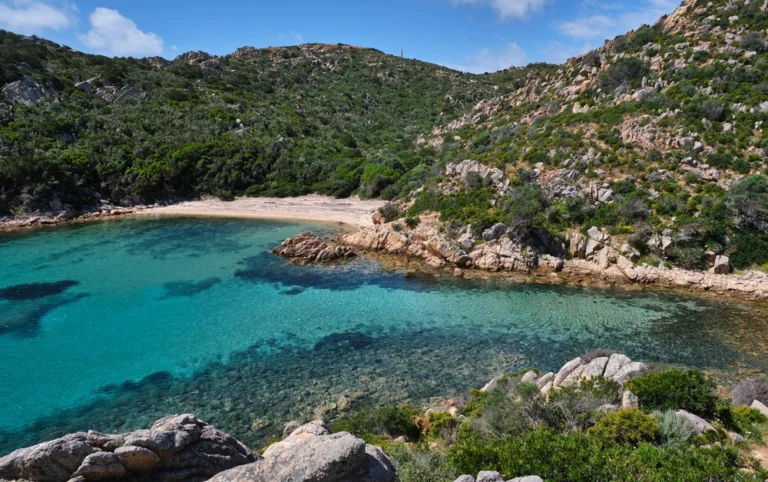
Caprera is famous for its beaches, but be warned: you won’t find any beach clubs, pay-to-use parasols or drinks kiosks here. Instead, you’ll find unspoilt nature, turquoise waters and fine white sand. Here are the ones you absolutely must see.
Cala Garibaldi is the most popular and easiest to reach. Park your car, walk for two minutes, and you’re in the water. The seabed is shallow and sandy, perfect for families. The water is so clear that you can see your feet even at a depth of three metres.
Cala Napoletana is a bit more secluded. It takes about an hour’s walk through the Mediterranean scrub to get there, but the effort is well worth it when you reach this small, intimate cove, surrounded by pink granite rocks. It’s the perfect spot if you’re looking for peace and quiet and want to hear nothing but the sound of the waves.
Cala Portese, also known as “dei Due Mari”, is a wide stretch of white sand lapped by very shallow waters. What makes it special? The water laps both sides of the cove, creating a natural swimming pool effect. It’s perfect if you’re with young children or if you want to be in the water without having to worry about the depth.
And then there’s Spiaggia del Relitto. The name says it all: on the shore lies the skeleton of an ancient ship, emerging from the sand. It’s picturesque, photogenic and less crowded than the others.
Cala Coticcio, the “Sardinian Tahiti”: is it really that beautiful? How do you get there?
Now let’s talk about Caprera’s most precious gem. Cala Coticcio is nicknamed the “Sardinian Tahiti”, and it’s no coincidence. The water has a fluorescent turquoise hue that you’ve never even seen in a photo. The sand is incredibly fine, almost like flour. The pink granite rocks create a picture-postcard landscape.
But there is a problem—or rather, a rule. For some years now, access to Cala Coticcio by land has been subject to a quota. You can only enter if accompanied by a nature guide authorised by the La Maddalena Archipelago National Park. The number of daily visitors is limited to protect the ecosystem. You must book weeks in advance, especially in summer. Alternatively, you can admire it from the sea: many boat tours they stop in the waters off the coast to go snorkelling.
Is it worth it? Yes, absolutely. But bear in mind that there are no bars, facilities or shade. You’ll need to bring your own water, food and sun cream, and take all your rubbish back with you. And don’t even try to take a single grain of sand: the fines are extremely steep.
What to do in Caprera when it rains? Military history, bunkers and birdwatching
Caprera isn’t just about the sea. In fact, if you happen to catch a windy or rainy day, you’ve got an excellent Plan B: military history. During the Cold War, the island was home to a secret NATO base nicknamed “Little America”. Today you can visit bunkers, radar stations and coastal batteries such as the Punta Rossa and Poggio Rasu batteries. Some areas are still off-limits (still NATO property), but those that are accessible are fascinating and rarely visited.
If you love animals, bring a pair of binoculars. The Cala Napoletana area is home to the Corsican seagull, one of the rarest birds in the world (there are only around 150 pairs left). With a little patience and silence, you can see it flying just a few metres away from you. Also there, on the cliffs overlooking the sea, lives the peregrine falcon.
And if you fancy a hike, the Garibaldi Trail links the Compendio to Forte Arbuticci. It’s a walk of about two hours through Mediterranean scrub and maritime pines, with views of the archipelago. Make sure you bring trainers and a bottle of water.
Is there anywhere to stay in Caprera? Where to eat and how to get around
The million-dollar question: can you stay overnight on Caprera? The answer is no. There are no hotels, B&Bs or holiday homes. Camping is strictly prohibited across the whole island. The only exception is the Caprera Sailing Centre, a historic sailing school that offers accommodation only to its students during courses. So, if you’re not enrolled on a sailing course, you’ll have to stay elsewhere.
The best option is to stay on the island of La Maddalena, which is just a few minutes’ drive from the bridge. Alternatively, you can stay in Palau, Santa Teresa Gallura or on the Costa Smeralda. From there, take the ferry every morning and in 20 minutes you’ll be in La Maddalena; then cross the bridge and you’ll be in Caprera.
There are no restaurants on Caprera where you can eat. Bring a packed lunch. The only place to get something to eat is a small kiosk near Cala Garibaldi (open only in high season and with limited opening hours). So: pack a rucksack with sandwiches, fruit, plenty of water and a beach towel.
How to get around? A car is convenient, but there are few parking spaces. In July and August, if you arrive after 10 am, you’ll be driving around for half an hour without finding a space. Better to go by bike or scooter, which you can hire in La Maddalena. Cycling along the scenic road that runs alongside Cala Portese and Punta Rossa is a wonderful experience.
The 5 golden rules for visiting Caprera without getting fined (and without feeling guilty)
Caprera is a protected area, part of the La Maddalena Archipelago National Park. And the park has strict rules. Here are the ones you absolutely must follow if you don’t want to ruin your holiday with a hefty fine.
Firstly: it is forbidden to take sand, shells or pebbles. It may seem like a trivial rule, but every summer tourists are stopped with jars of pink sand or shells in their rucksacks. The fine starts at 500 euros. Don’t do it.
Secondly: do not anchor freely in marine areas. Use only the designated buoys, otherwise you risk damaging Posidonia, a protected marine plant that is vital to the ecosystem.
Thirdly: camping and lighting fires are prohibited across the whole island. There are no designated camping areas. If you want to sleep under the stars, go somewhere else.
Fourthly: dogs are not permitted on the beaches during the summer season, except in designated areas. Caprera is not a pet-friendly island like others. There are nesting areas for extremely rare birds, and dogs—even when on a lead—stress them out.
Fifth: please keep quiet in nesting areas. Do not shout, play music or use drones. The national park may confiscate your drone and fine you.
It may seem like a lot of rules, but they are the only reason Caprera is still so beautiful. By following them, you’re ensuring that future generations can enjoy the same crystal-clear waters that you see today.
Fun facts about Caprera that you (might) not know and that will amaze your friends
Before I go, I’d like to share three interesting facts with you that you can tell your friends whilst you’re lying on the beach.
First interesting fact: the name Cala Coticcio derives from the local dialect and means “hiding place”. In the past, Barbary pirates used this cove to hide the booty they had stolen from passing ships. It is said that Ottoman coins still lie buried beneath the sand. No one has ever found them, but the mystery makes the place all the more fascinating.
Another interesting fact: Garibaldi used to swim naked at Cala Serena. He wrote about it in his diaries. Today, Cala Serena is one of the quietest coves on Caprera, and who knows – perhaps the hero chose that very spot for the sake of his privacy.
Third interesting fact: the Passo della Moneta, the bridge connecting Maddalena and Caprera, is not a man-made bridge. It is a natural isthmus of sand and rock. At high tide, the water partially covers it, creating the illusion that the two islands are separating once more. If you cross it at sunset when the tide is high, it feels as though you are walking on water.
The best time to visit Caprera (and why you should avoid August)
When is the best time to visit Caprera? I’ll put it bluntly. The best months are May, June, September and October. During these months, the weather is warm but not sweltering, the sea is already suitable for swimming from mid-May until the end of October, and, above all, there are no crowds. The ferries aren’t packed, you can find parking, and the beaches don’t feel like a madhouse.
July and August are lovely, of course. But you need to know what to expect: queues for the ferry from Palau, nowhere to park, packed beaches, and the need to book everything weeks in advance (boat trips, a guide for Cala Coticcio, ferries with your car). If you have a choice, avoid the first half of August. If you don’t, be prepared to wake up at 7.30 am and be on the beach by 9.00 am.
Another insider tip: the wind. Caprera is exposed to the mistral and the libeccio. If you see a red flag at the harbour, it means rough seas and many beaches will be dangerous or closed. On those days, spend your time visiting the Compendio Garibaldino, the bunkers and the inland trails. Caprera isn’t just about the sea, as I’ve told you.
Plan your day in Caprera: an example of the perfect itinerary
If you’d like some practical advice, here’s the itinerary I recommend to anyone who asks me how to spend a perfect day in Caprera.
Wake up at 7.30 am, take the ferry from Palau to La Maddalena at 8.30 am. Get off, cross the bridge and you’ll be in Caprera by 9.00 am. First stop: Compendio Garibaldino. You arrive early, there’s no queue, and you can visit the house and the tomb in an hour.
At 10.30 am, head to Cala Garibaldi. There’s plenty of parking, and you can get straight into the water. Have your first swim of the day.
A packed lunch on the beach or on a scenic rock.
In the early afternoon, a walk to Cala Napoletana. After an hour’s walk through the Mediterranean scrub, you arrive to find fewer people. Second swim.
At around 4 pm, we set off up towards Monte Tejalone. At 212 metres, it is the highest peak on Caprera. It’s not an impossible climb, but the view over the entire Maddalena archipelago makes every drop of sweat worthwhile.
Descent and return to La Maddalena. Dinner in the harbour at La Maddalena – fresh fish – followed by the ferry back to Palau. A perfect day.
Conclusion: Caprera awaits you, but with respect
Caprera is not like other islands. It is not Ibiza, it is not Mykonos, it is not a destination geared towards mass tourism. It is a wild, unspoilt, peaceful island. It is the place where Giuseppe Garibaldi chose to die. It is one of the most precious areas of the La Maddalena Archipelago National Park.
Visiting it is a privilege, not a right. And like all privileges, it must be earned through respect. Follow the rules: don’t take any sand, don’t leave any rubbish behind, and don’t make noise where birds are nesting. Only in this way will Caprera remain the gem it is today.
And if you do, you’ll take home something far more beautiful than a shell or a jar of pink sand: you’ll take home a genuine memory, made up of turquoise water, pink granite and that sense of peace you find only in places where nature still reigns supreme.
Have a good trip to Caprera.