
Cala Granara Santo Stefano: the pink granite beach that beats Cala Coticcio (and why so few people know about it)
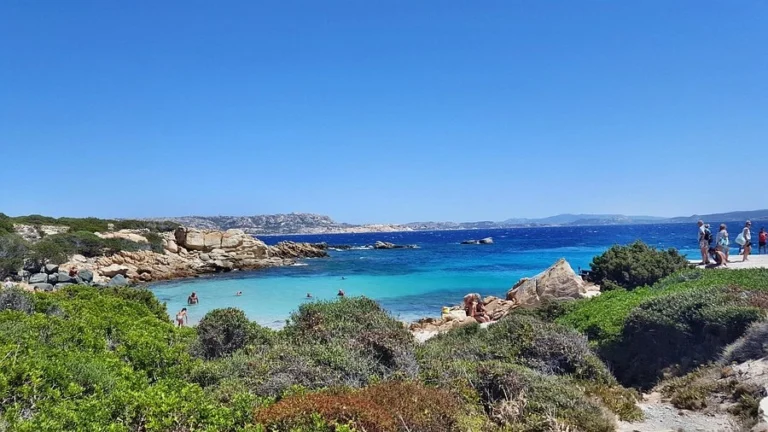
Did you know that there’s a beach in the Maddalena Archipelago with emerald-green water, snow-white sand, and pink granite rocks shaped like natural sculptures, and without the crowds of Cala Coticcio or Spiaggia Rosa? It is called Cala Granara, it is located on the island of Santo Stefano, and it is one of the most spectacular and least visited coves in the entire national park.
In this guide, you will discover:
Where is Cala Granara and why is it called that?
How to get there (it’s impossible to get there by land; only by sea)
Because it’s better than Cala Coticcio (and many other famous beaches)
What to see apart from the beach: the bunkers, the carved granite, the sea caves
All the practical tips you need for a perfect day
Reading time: 6 minutes. By the end, you’ll know whether Cala Granara is the right beach for you and how to plan your visit.
What is Cala Granara and why is it called that?
Cala Granara is a beach situated on the north-western coast of the island of Santo Stefano, in the heart of the Maddalena Archipelago. It is considered by many boaters and locals to be the most beautiful beach on Santo Stefano, and one of the most beautiful in the entire national park.
The name “Granara” derives from “granite”, the rock that makes up almost the entire island. But there is a play on words: in the Gallurese dialect, “granara” also means “a place where wheat is harvested”. In reality, wheat has never been grown on Santo Stefano. The name is a tribute to the texture of the sand: fine, golden, which in the sun seems almost to glisten like grains of wheat.
The beach is a crescent of fine white sand, about eighty metres long and twenty metres wide. It is framed by imposing pink granite rocks, smoothed by the wind and the sea over thousands of years. Some of these rocks have surprising shapes: there is one that looks like an elephant, one that looks like a giant mushroom, and one that the locals call “the general’s chair” (it is said that a commander from the NATO base used to sit there and watch the sunset).
The water at Cala Granara is spectacular: crystal-clear, with shades ranging from emerald green near the shore to deep blue further out. The seabed is varied: very fine sand near the water’s edge, then small smooth pebbles, and finally rock and Posidonia. The depth increases gently, making it suitable even for those who aren’t strong swimmers.
A detail you won’t find anywhere else: Unlike many beaches in the archipelago, Cala Granara faces north-west. This means it gets the sun from morning until late afternoon, but at sunset the sun is hidden behind the rocks. To watch the sunset, you’ll need to head to the other side of the island. However, the afternoon light is warm and golden, perfect for photos.
Where is Cala Granara? The island of Santo Stefano and its strategic location
Cala Granara is located on the island of Santo Stefano, the fourth-largest island in the Maddalena Archipelago. Santo Stefano is situated south-east of the island of La Maddalena, about two kilometres from the town of La Maddalena, and north-west of the island of Caprera.
The exact coordinates are as follows: latitude 41 degrees 12 minutes north, longitude 9 degrees 24 minutes east. But that won’t be much use to you. What you need to know is that Cala Granara is located on the north-western coast of the island, directly opposite the former NATO base.
The location is strategic for two reasons. Firstly, it is sheltered from the prevailing winds. The mistral, blowing from the north-west, is deflected by the rocks behind it. The south-westerly wind arrives in a more subdued form. Consequently, even when there are waves in other coves of the archipelago, Cala Granara is often completely calm.
Secondly: it’s close to La Maddalena. Just two kilometres across the sea. In a dinghy, you can get there in under ten minutes. In a kayak, it’s a leisurely half-hour paddle. This makes it accessible even to those without a powerful boat or much sailing experience.
What's nearby: A few hundred metres east of Cala Granara lie the buildings of the former NATO base. They are not accessible, but can be clearly seen from the sea. To the west, on the other hand, there are small, secluded coves, reachable only by swimming or in small rubber dinghies. They are ideal for those seeking even greater seclusion.
How do you get to Cala Granara? (Spoiler: you can’t get there by land)
This is the most important question – and also the answer that disappoints many tourists. Cala Granara cannot be reached by land. There are no roads, no marked footpaths, and no car park. The island of Santo Stefano is largely a military zone (a former NATO base), and the only access permitted to civilians is via Cala Granara and the short path leading from the beach inland. But to reach Cala Granara, you have to come by sea.
Here are the ways to get there.
With an organised boat tour
The simplest and most common way. Many boat tours departing from Palau, La Maddalena or Santa Teresa Gallura include a stop at Cala Granara. Usually, the standard itinerary includes: La Maddalena (tour of the island), Caprera (Cala Coticcio or Cala Napoletana), Budelli (view of the Spiaggia Rosa), and then Santo Stefano (Cala Granara). The stop lasts on average an hour or an hour and a half. Enough time to have a swim, take photos, and perhaps do a bit of snorkelling.
The advantage: you don’t have to worry about a thing. The guide takes you straight to the right spot, tells you the story of the island and the bunkers, and manages the timetable. The downside: you’re in a group. In high season, as many as five or six dinghies can arrive at Cala Granara at the same time. The beach is small, just eighty metres long. If there are a hundred people there, the intimate atmosphere disappears.
Council: Choose a boat tour that sets off early in the morning (8.30–9.00 am). You’ll arrive at Cala Granara when the other tours are still elsewhere. You’ll often be on your own, or nearly so.
By hire boat
The best option if you want freedom and flexible hours. Hire a dinghy in La Maddalena (there are several companies near the harbour) and sail over to Santo Stefano on your own. It’s only a short distance: it’s about two kilometres from the harbour in La Maddalena to Cala Granara. A ten-minute sail, or even less.
Once you arrive, you can moor in the waters off the beach. Please note: you are not allowed to anchor freely. There are buoys belonging to the La Maddalena Archipelago National Park to which you must tie your dinghy. The cost is just a few euros per hour or per day. Do not attempt to pull the dinghy onto the beach: the sand is soft and the seabed shallow, but it is prohibited (you will damage the Posidonia and coastal vegetation).
The advantage: you’re on your own. You choose the time. You can stay as long as you like. You can explore the other coves in the area. The disadvantage: you need to have sailing experience, or at least some basic familiarity with it. What’s more, in high season, you need to book the dinghies days in advance.
Council: If you’ve never driven a dinghy before, take a half-hour taster course. Rental companies often offer this for free. Learn how to use the GPS, spot the buoys and handle the anchor.
By sea kayak
For sports enthusiasts and adventurers. Hire a kayak (single or double) in La Maddalena and paddle over to Santo Stefano. The crossing is short (two kilometres), but should only be attempted in calm seas and with no wind. The Strait of Bonifacio is famous for its unpredictable currents. Check the conditions beforehand.
The advantage: a unique experience. You reach the beach entirely under your own steam, without an engine, in complete silence. You can explore caves and nooks that rubber dinghies can’t reach. The disadvantage: it’s hard work. And you have to carry everything you need (water, food, sun cream) in waterproof bags.
Council: Set off early in the morning, when the sea is calmest. Don’t go alone: take at least two kayaks with you for safety’s sake. Take a mobile phone with you in a waterproof bag.
Why Cala Granara is better than Cala Coticcio (and other famous beaches)
That’s quite a bold statement, I know. Cala Coticcio is known as the “Sardinian Tahiti”; it’s famous all over the world and features in every guidebook. But Cala Granara has certain advantages that make it, in many ways, superior.
Advantage 1: fewer crowds. Cala Coticcio is accessible by land (with a guide and a permit) and by sea. It receives hundreds of visitors a day in high season. Cala Granara, being accessible only by sea and situated on a partially military island, is much less crowded. Even in August, if you choose the right time, you can find few dinghies and plenty of peace and quiet.
Advantage 2: nicer sand. Cala Coticcio has a tiny beach, which is often submerged at high tide. Most of the coastline is rocky. Cala Granara has eighty metres of fine, soft sand, with a gentle, gradual entry into the water. Perfect for families and anyone looking for a comfortable spot.
Advantage 3: a safer seabed. At Cala Coticcio, the seabed drops off sharply. Just a few metres from the shore, the water is already two or three metres deep. At Cala Granara, the depth increases gradually. Children can play in the water without any risk.
Advantage 4: carved granite. The rocks at Cala Granara are spectacular. They look like abstract sculptures. Some have incredible shapes: one that resembles an elephant, one that looks like a giant mushroom, and one with a natural cave that fills with water at high tide. Cala Coticcio has beautiful rocks, but they are more rugged and jagged.
Benefit 5: snorkelling. The seabed at Cala Granara is teeming with life. Among the pebbles and Posidonia beds, fish of all kinds swim: damselfish, sea bream, saddled seabream, and, if you’re lucky, even the odd octopus. Snorkelling at Cala Coticcio is lovely, but the water is often too deep to see the seabed.
The only downside to Cala Granara: You can’t get there by land. You need a boat. But for many, this isn’t a drawback: it’s a filter that keeps the crowds at bay.
Things to do in Cala Granara besides swimming: snorkelling, photography and exploring
Cala Granara isn’t just a beach for sun loungers and parasols. It offers a range of activities.
Snorkelling. The water is crystal-clear and the seabed is varied. The best spots are at the sides of the beach, where the sand gives way to rocks. There you’ll find crevices, small caves and a myriad of fish. Bring a mask and flippers. If you have an underwater camera (GoPro or similar), bring it along. The colours are spectacular.
Photography. Cala Granara is one of the most photogenic beaches in the archipelago. The best subjects: the sculpted granite rocks (in the morning, with the light coming from the east, and in the afternoon, with the warm light), the emerald-green water seen from above (if you can climb up onto a rocky outcrop), and the bunkers in the background (the contrast between the natural beauty and the abandoned military structures is striking).
Exploring rocks. Walk along the coast, both eastwards and westwards. To the east, after about a hundred metres, you’ll find a series of small side coves, accessible on foot (be careful: some sections require you to climb over rocks). To the west, however, you’ll find the first structures of the former NATO base. Don’t go past the ‘No Entry’ signs, but they make for a nice photo from a distance.
A picnic on the beach. There are no kiosks or cafés. Bring a packed lunch. Choose a shady spot (the rocks only provide shade at certain times of day). Eat with your feet in the sand, gazing out at the sea. It’s one of the simplest and most beautiful experiences you can have.
A walk to the summit. An unmarked but passable path leads from the beach, winding its way inland. In just a few minutes, you’ll reach a small natural viewpoint. From there, you can see the whole of Cala Granara from above, with the islands of La Maddalena and Caprera on the horizon. The path is short and suitable for everyone. Please note: do not proceed beyond the ‘No Entry’ signs for the military area.
What’s near Cala Granara? The other coves around Santo Stefano
Santo Stefano has other small coves, less well-known but just as beautiful. Here are the main ones.
Cala del Morto. It is situated south of Cala Granara, on the east coast. Its eerie name derives from a shipwreck that occurred in the 19th century. It is a sheltered cove of sand and pebbles, ideal for those seeking complete seclusion. It can only be reached by boat, and caution is advised as there are exposed rocks.
Cala dei Francesi. On the south-west coast. It takes its name from a raid by the French navy in the 18th century. It is a tiny beach, almost a narrow strip between the rocks. The water is incredible, but there is only room for a few dinghies.
The Santo Stefano Swimming Pools. It isn’t a beach, but a series of natural pools carved out of the granite by erosion. They are located on the north-east coast, near the former NATO base. They can only be reached by swimming or in small kayaks. The water is shallow and very warm in summer, perfect for relaxing.
Council: If you have a dinghy, after Cala Granara, take a trip around the island. In less than an hour, you’ll see all these coves and bunkers, and you can go for a swim in places where other tours don’t stop.
When is the best time to visit Cala Granara? The best time of year and the best time of day
Cala Granara is beautiful in every season, but there are better times to visit.
Best time to visit: May, June, September and October. At this time of year, the weather is warm but not sweltering, the sea is perfect for swimming, and, best of all, there are no crowds. Boat tours are less frequent. If you arrive in your own dinghy, you’ll find few other boats and plenty of peace and quiet. What’s more, the wind is more consistent and the sea calmer.
July and August. These are the busiest months. Cala Granara sees dozens of dinghies arriving every day. The beach can look like a small, crowded lido. But if you choose the right time, you can still enjoy it: arrive before 10:00 or after 16:00. At those times, the boat tours are elsewhere.
The right time. Early morning (8:00–10:00) is the best time. The sun bathes the beach in soft light, the water is calm, and most tourists are still having breakfast in La Maddalena. The afternoon (4.00–6.00 pm) is lovely for the warm light, but the wind often picks up.
Watch out for the wind. Cala Granara is sheltered, but not completely. If there is a strong mistral (over 20 knots), waves break into the cove and the water becomes murky. If there is a south-westerly wind, however, the cove is almost always calm. Check the wind forecast before setting off.
What to pack for a day out at Cala Granara (ready-made checklist)
There are no facilities at Cala Granara. None whatsoever. So you’ll need to bring everything with you. Here’s the list.
Water. At least two litres per person. There’s no drinking fountain. There’s no kiosk. The only water available is what you bring with you.
Packed lunch. Sandwiches, fruit, snacks, energy bars. There are no restaurants. There are no grills. Eat what you bring with you.
Sun cream. High protection (50). The sun’s glare off the granite and water is very strong.
A cap and sunglasses. Essential. Especially if you’re arriving by dinghy and spending hours in the sun.
Diving mask and fins. For snorkelling. Cala Granara is a little underwater paradise.
Beach towel. A normal one. You don't need the thick one.
Rock-climbing shoes. Essential. The beach is sandy, but you’ll need water shoes if you want to enter the water from certain spots along the shore or walk on the rocks. The granite is sharp.
Waterproof rucksack or waterproof bags. If you’re arriving by dinghy or kayak, make sure to keep your phone, keys and documents safe. Water always splashes.
Power bank. There are no power sockets. If you use your phone as a camera, the battery won’t last as long.
A bin bag. There are no bins. You take everything with you, and you bring it all back.
Snorkelling (I’ll say it again, because many people forget): a mask and fins. There’s no hire shop. You’ll need to bring your own.
A lightweight beach parasol. If you’re arriving with a large inflatable, you can bring it. But be careful: you can’t just plant it anywhere. The roots of Mediterranean scrub plants are shallow. Choose a spot where you won’t damage the vegetation. Better still, use a parasol that you can secure to the rock with weights.
The rules of the National Park at Cala Granara (please read before you go)
Cala Granara is located within the La Maddalena Archipelago National Park. The rules are clear and must be observed.
Please do not take any sand, shells or pebbles. The fine starts at €500. Don’t do it.
No free mooring. Please use the marked buoys. There is a charge for this (a few euros per hour or per day). Anchoring in the Posidonia seagrass beds is prohibited and damages the ecosystem.
No smoking. There is an extremely high risk of fire in the Mediterranean scrub. A cigarette that hasn’t been properly extinguished can burn down hectares of vegetation.
Beach umbrellas are not permitted on the sand. Yes, you’ve got it right. It’s forbidden to put parasols in the sand. Parasols damage the vegetation on the dunes (even though you might not think so, there are tiny plants growing in the sand). Use a sunshade or a beach towel instead.
Dogs are not allowed. During the high season, dogs are not allowed on the park’s beaches. Not even on a lead.
Take the rubbish away. There are no bins. Whatever you bring in, you take back with you.
The use of drones is prohibited. Without authorisation from the national park, this is prohibited. A fine and confiscation of the item will be imposed.
Camping and lighting fires are prohibited. Of course.
These rules aren’t a nuisance. They’re the only reason Cala Granara is still so beautiful. Please respect them.
Cala Granara with children: yes or no?
Yes, absolutely. Cala Granara is one of the most child-friendly beaches in the whole archipelago.
Why? The seabed is sandy and gently sloping. There are no sudden drops. The water is calm (the bay is sheltered). The beach is small, so children can’t wander too far. And the granite rocks, with their strange shapes, make a natural playground.
The only things to watch out for: the sun. There is no natural shade at Cala Granara (apart from the odd rock here and there). Bring a lightweight parasol or a sunshade. And the water: even though it’s shallow, never leave children unattended. There are currents, even if they’re weak.
A tip: Bring some beach toys (a bucket, spade and moulds). The sand is perfect for building castles. And bring a life jacket or armbands for the little ones. There is no lifeguard on duty.
How much does a day out at Cala Granara cost? (detailed budget)
Here is an example of a budget for a day trip to Cala Granara, departing from La Maddalena.
With tours in organised boat trip (adult):
Day trip (with stops at La Maddalena, Caprera, Budelli and Santo Stefano): €40–€60
Packed lunch: €10
National park ticket (usually included in the tour, but sometimes not): €3
Total: €53–73
With a hired dinghy (for two people, costs shared):
Inflatable boat hire for a day (August): €80–€120
Petrol: €20–€30
Mooring buoy at Cala Granara: €5–€10
Packed lunch for two: €20
National park ticket for two: €6
Total for two: €131–186 (€65–93 per person)
With a hire kayak (for two people):
One-day hire of a two-person kayak: €40–€60
Waterproof bags: €10 (if not provided)
Packed lunch for two: €20
Total for two: €70–90 (€35–45 per person)
The most economical option is a guided tour. The most flexible option is a rubber dinghy. The most adventurous option is a kayak.
Conclusion: Cala Granara, the beach you wouldn’t expect
Cala Granara isn’t as famous as Budelli’s Spiaggia Rosa. It isn’t as iconic as Cala Coticcio. It isn’t as accessible as Cala Garibaldi. And perhaps that’s precisely why it’s so special. It’s a beach you have to seek out, one you have to earn. Getting there requires a boat, a bit of planning, and a desire to get away from the most well-trodden tourist trails.
But when you arrive, when you see that crescent of white sand nestled between the pink granite rocks, when you feel the warm, crystal-clear water lapping at your feet, you realise why it’s all worth it. There’s no music, no queues, no selfie sticks invading your space. There is only the sound of the waves, the scent of the Mediterranean scrub, and the rare feeling of having found a corner of paradise that remains untouched.
The next time you’re in the Maddalena Archipelago, don’t just stick to the usual stops. Ask your skipper to take you to Cala Granara. Or hire a dinghy and go on your own. You’ll discover a beach you’ll never forget.
Enjoy a swim at Cala Granara, on the island of Santo Stefano.