
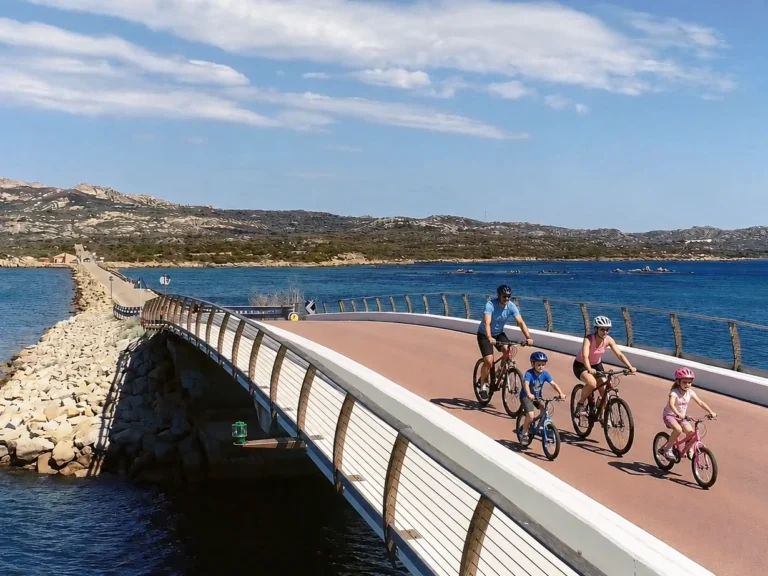
Caprera by bike: 5 routes to try at least once in your life (with or without an e-bike)
Did you know that Caprera has been described as “a hidden paradise for cyclists”? It is the only island in the Mediterranean where you can cycle through a national park and experience Italy’s history first-hand, swim in Caribbean-like waters and visit Giuseppe Garibaldi’s grave – all in the same day and without ever setting foot in a car.
In this guide you will find:
How long does it take to cycle around Caprera?
Where to hire an electric bike in La Maddalena (prices and tips)
The best route for sightseeing Cala Coticcio, the “Sardinian Tahiti”
Le Rules of the Archipelago National Park La Maddalena for cyclists
A question nobody ever asks you: why is the tarmac on Caprera rougher than usual?
Reading time: 8 minutes. In the end: you’ll know exactly whether to bring your own bike or hire one, and which route to choose based on your fitness level.
1. Have you ever wondered why Caprera is considered the most bike-friendly island in the Mediterranean?
Short answer: Because it’s small, safe and full of short climbs.
Long answer. Unlike the nearby Costa Smeralda, where the roads are narrow and full of SUVs, Caprera has just one tarmac road that runs almost the entire length of the island. Traffic is limited both naturally (there are no hotels or holiday resorts) and by law (much of the coastline is a restricted traffic zone within the La Maddalena Archipelago National Park).
The figure you need to know: The total elevation gain on the island is just 212 metres. That is the height of Mount Tejalone, the highest point. This means that even an eight-year-old child or a sixty-year-old with no particular fitness training can complete the full circuit without any difficulty.
What if I told you that the tarmac on Caprera is deliberately rougher than average? It’s no coincidence. The national park has opted for a rougher road surface to prevent cars from speeding at dangerous speeds. But there is another reason, romantic and a little crazy: to protect the hooves of the wild horses descended from Garibaldi’s. Yes, they still exist, and sometimes you come across them as you cycle towards Punta Rossa.
Practical tip: If you want the quietest roads, cycle between 8.00 and 10.00 in the morning. The tourists’ cars arrive later, with the 9.30 ferries. During that golden hour, the island is all yours.
2. How do you get to Caprera by bike? (ferry, bridge and what nobody tells you)
The answer in three steps:
Take a ferry from Palau to La Maddalena (15–20 minutes)
Cross the Passo della Moneta, the bridge linking La Maddalena to Caprera
You’re on the island. Start cycling.
How much does it cost to take a bike on the ferry? It depends on the company. On average, a standard bicycle costs between €3 and €5 each way. Electric bikes are charged the same rate. Some companies offer free bike transport during the low season (May and September). Always check the company’s website before you set off.
What if you don't have a bike? Boat hire in La Maddalena. In the town centre, just a short walk from the landing stage, there are at least six boat hire shops. The prices are as follows:
City bikes: €12–15 per day
Mountain bikes: €15–20 per day
Electric bike: €30–40 per day
Tandem or cargo bike: €40–50 per day
Please note: In July and August, without a booking, you’re unlikely to find an e-bike. Shops sell out days in advance. Book online at least a week in advance.
The most common oversight: Nobody tells you that the Passo della Moneta bridge has a cycle path separate from the road. It’s nearly two metres wide, safe, and as you cross it you’re treated to a spectacular view of the Strait of Bonifacio. Stop halfway across the bridge for a photo. Everyone does it, but for a reason: it’s one of the few places in the world where you can see two islands (La Maddalena and Caprera) and the open sea, all in a single glance.
3. What are the 5 cycling routes on Caprera? (details including duration and difficulty)
Here are the five routes I’ve tried out myself. For each one, you’ll find: duration, difficulty, what you’ll see, and whether it’s suitable for children.
Route 1: The west coast (the most scenic)
Departure and arrival: Passo della Moneta – Punta Rossa (round trip)
Length: 15 km
Duration: 2–3 hours, including breaks
Difficulty: easy (a few short climbs)
What do you see: Cala Garibaldi, Cala Serena (within walking distance of the car park), Cala Portese, Punta Rossa, the NATO bunkers
Suitable for children: Yes, if you just do the excerpt as far as Cala Garibaldi (5 km there and back)
The detail you won’t find anywhere else: On the road between Cala Garibaldi and Punta Rossa, after about a kilometre, there is a sharp bend to the right. Stop there. There is a granite rock that looks like a chair. It is called “Garibaldi’s Chair” (not officially, but the locals call it that). It is said that the hero used to sit there watching the sunset. Legend or history? It doesn’t matter. The view is real.
Route 2: The east coast (the wildest)
Departure and arrival: Passo della Moneta – Cala Napoletana (round trip)
Length: 18 km
Duration: 3–4 hours, including breaks
Difficulty: moderate (unpaved paths, strong winds)
What do you see: Cala Coticcio (the “Sardinian Tahiti”), Cala Napoletana, cliffs rising sheer from the sea
Suitable for children: No, because of the dirt track and the wind
Please note: This route is suitable for mountain bikes or hybrid bikes. City bikes won’t manage it. In the last two kilometres before Cala Napoletana, the tarmac ends and a track of fine gravel begins. It’s passable, but tricky on smooth tyres.
A possible sighting: If you cycle quietly, especially early in the morning, you might spot the Corsican seagull. It is one of the rarest birds in the world. There are only about 150 pairs left, and Caprera is one of the few places where it nests. It is easy to spot: it is darker than other seagulls, with a bright red beak and black legs. If you see one, stop at a distance. Do not approach it. It is a protected species within the La Maddalena Archipelago National Park, with fines of up to two thousand euros for disturbing it.
Route 3: The full loop of Caprera (for the fittest walkers)
Departure and arrival: Passo della Moneta (closed circuit)
Length: 25 km
Duration: 4–5 hours, including breaks
Difficulty: upper-middle (longer climbs, mixed terrain)
What do you see: all the beaches, Mount Tejalone, the island’s interior, the Garibaldi Complex
Suitable for children: only if you are over 12 and have had training
The secret of this tour: The inland section, which branches off from the coast to wind its way through the heart of Caprera, is the least frequented. Here, you cannot see the sea for almost two kilometres. You see only Mediterranean scrub up to two metres high, maritime pines, and absolute silence. In spring, between April and May, the flowering of rockroses and broom fills the air with a sweet, intense fragrance. It is my favourite stretch.
Route 4: The Bunker Trail (military history by bike)
Departure and arrival: Punta Rossa – Poggio Rasu Battery
Length: 8 km (the themed section only)
Duration: 1–2 hours
Difficulty: easy
What do you see: former NATO bases, radar stations, and coastal guns from the Second World War
Suitable for children: Yes, I really like it
What makes this route special: During the Cold War, Caprera was home to a secret NATO base nicknamed “Little America”. Today, you can freely visit several abandoned structures. The most impressive is the Punta Rossa Battery: four enormous guns still pointing out to sea, surrounded by concrete bunkers two metres thick. Entry is free and unrestricted, but some areas are still NATO property and are off-limits. Please respect the signs.
Route 5: Garibaldi’s route (from his grave to the sea)
Departure and arrival: Garibaldi Compendium – Cala Garibaldi
Length: 3 km (one way)
Duration: 30 minutes’ cycling + 1 hour’s museum tour
Difficulty: easy
What do you see: Garibaldi’s house-museum, his grave, the beach where he used to swim
Suitable for children: yes
The exciting detail: Garibaldi’s grave lies hidden amongst the towering eucalyptus trees that he himself planted. Why eucalyptus trees? Garibaldi was convinced that their scent repelled mosquitoes and prevented malaria. He was wrong (malaria is transmitted by the Anopheles mosquito, which eucalyptus does not deter), but he gave Caprera one of its most evocative spots. Today, those trees stand over thirty metres tall. Cycling along the avenue leading to the grave, with the light filtering through the branches, is an almost mystical experience.
4. Electric or traditional bike in Caprera? The definitive answer
The short answer: If you never cycle or are over 55, go for an electric bike. If you’re fit, a standard bike will do.
The long answer. I’ve tried both options in different years, and I’ll be honest with you. On a traditional bike, the climb up Monte Tejalone (two kilometres at an average gradient of 7%) will make you sweat. But the descent, with the wind drying you off and the sea suddenly coming into view, is pure joy.
With an electric bike, you hardly feel any strain at all. You can complete the full 25-kilometre loop in two hours without breaking a sweat. You can focus on the scenery and stop to take photos without worrying about having to climb back up again. It costs more, but it makes cycling a real pleasure.
Here are the figures: A fully charged 100% e-bike battery gives you a range of 60 to 80 kilometres on mixed terrain. Caprera is 25 kilometres long at most. That means you can complete the circuit twice on a single charge and still have some left over. So no need to worry about running out of battery.
An insider's tip: Bicycle hire shops in La Maddalena often stock electric bikes with Bosch or Shimano batteries. Avoid unbranded Chinese models. They cost a few euros more, but you won’t risk being stranded at Punta Rossa with a flat battery.
5. What should you pack in your rucksack for a day’s cycling on Caprera? (print-ready list)
Water. There are no drinking fountains. There are no shops along the route (apart from a kiosk in Cala Garibaldi, which isn’t always open). The rule is: two litres per person in summer, one and a half in spring and autumn.
Packed lunch. Sandwiches, dried fruit, fresh fruit, energy bars. There are no restaurants on Caprera. If you arrive without any food, you’ll end up eating rocks.
Sun cream. The sun cream you use at the beach isn’t enough. The sun’s glare off the tarmac and granite can burn you in places you wouldn’t expect: under your chin, behind your ears, and on your hands. Use SPF 50.
A cap and sunglasses. The wind whips up fine sand. Sunglasses protect you from that too.
Diving mask and fins. Read them. Pop them in your rucksack. The snorkelling is superb in all the coves around Caprera.
Lightweight beach towel. Not a thick beach towel. One of those that dry in five minutes.
Lightweight windbreaker. The weather changes in a flash. A summer storm over the Strait of Bonifacio can roll in within ten minutes. Being soaked to the skin on a bike isn’t much fun.
Mobile phone power bank. You’ll be using GPS, taking photos, and the battery will drain quickly. A 10,000 mAh power bank will last for two days.
Repair kit. If you hire a bike, the shop will provide you with an inner tube and a pump. If you’re bringing your own bike, bring them with you. A puncture at Punta Rossa, 5 km from the bridge, under the blazing sun, will ruin your day.
Documents and cash. Not all kiosks accept cards. And mobile coverage on Caprera is patchy at best. Cash comes in handy.
6. What are the National Park rules for cyclists on Caprera?
Rule number 1: Stay on the marked trails. Cycling off-road in the Mediterranean scrub is prohibited. Fines start at €150.
Rule number 2: Please don’t leave any rubbish behind. There are no bins. Whatever you bring with you, you must take it back with you.
Rule number 3: Respect for wildlife. If you see a Corsican seagull or a peregrine falcon, stop. Do not approach them. Do not make any noise.
Rule number 4: No drones. The national park prohibits them without authorisation. If you’re caught, your drone will be confiscated and you’ll be fined (from €500 upwards).
Rule number 5 (only for dog owners): In summer, dogs are not allowed on the beaches of Caprera. Not even on a lead. The fines are hefty. Leave your dog at home or in La Maddalena.
A rule that nobody reads but is important: Silence. Please do not play loud music. Please do not shout across the water to your friends. Caprera is one of the few places in Italy where you can still hear the sound of the wind and the waves without human interference. Please respect this.
7. Cycling in Caprera with children: yes or no? (and how to do it)
Short answer: Yes, but with preparation.
Long answer. The recommended minimum age for a 10-kilometre ride is 6–7 years, provided the child is used to cycling. For younger children (aged 3–5), hire a rear child seat (some shops in La Maddalena stock them) or a cargo bike.
The route best suited to children: from the start of the footbridge at Cala Garibaldi and back. It’s a flat 10-kilometre walk in total, with a beach halfway along where you can stop for two hours. An 8-year-old can manage it easily.
What to pack for the children: plenty of water (they sweat more than adults), sweet snacks (a chocolate bar works wonders for their spirits), plasters (bike falls, even minor ones, do happen), a spare T-shirt (they arrive at the beach sweaty and then get chilled by the wind).
A tip that works: turns the bike ride into a treasure hunt. “We have to find Garibaldi’s chair”, “Who’ll be the first to spot the Corsican seagull?” (even if you don’t see it, the anticipation keeps things exciting). Children get bored if the only aim is to cycle. Give the adventure a sense of purpose.
8. When is the best time to cycle to Caprera? (month by month)
May and June: The best time of year. Temperatures between 22 and 28 degrees. The sea is already warm enough for swimming from the second half of May. Few crowds. The ferries aren’t full. Bike hire prices are lower. Moderate winds.
July and August: Hot (often over 35 degrees). Crowded. Full car parks. But if you cycle early in the morning (8:00–10:00) and late in the afternoon (17:00–19:00), you’ll still find the roads deserted. The crowds head to the beach, not out on their bikes.
September and October: the second-best time of year. Temperatures similar to those in May. The sea remains warm until mid-October. In September, the water is even warmer than in June. Crowds thin out dramatically after 15 September.
From November to March: Technically, you can cycle, but it’s cold (10–15 degrees), it rains often, and the wind is strong. What’s more, many facilities (bike hire, kiosks) are closed. Only for die-hard cyclists.
9. How much does a day’s cycling in Caprera cost? (detailed budget)
Here is an example of a budget for one person during the high season (August):
Palau–La Maddalena return ferry ticket (including a bike): €12–15
Electric bike hire for a day: €35
Packed lunch (water, sandwiches, fruit): €10
National Park entry ticket (for access to the protected beaches): €3
Total: around 60–65 euros per person
If you have your own bike and bring a packed lunch, you’ll only need to pay for the ferry (€12–15) and the ticket (€3). Total: less than €20 for a full day. It’s one of the cheapest ways to visit the Maddalena archipelago.
10. The 5 questions Google won’t answer about cycling on Caprera (but I will)
Question 1: Can I take my bike on the path to Cala Serena?
No. The path is a narrow, rocky footpath. Bikes can’t get through. Park at Cala Garibaldi and walk. The walk takes 15–20 minutes.
Question 2: Is there a dedicated cycle path covering the whole island?
No. You cycle on normal roads, shared with cars. But there isn’t much traffic and the road is wide. In many places, there is a white line marking out an informal “lane” for bikes.
Question 3: Can I cycle around Caprera in an hour?
If you’re an athlete, yes. The full circuit is 25 km. At an average speed of 25 km/h, it takes exactly an hour. But you wouldn’t have seen a thing; you wouldn’t have stopped once. The whole point of cycling in Caprera is to stop.
Question 4: Are there any places on the island where you can charge electric bikes?
No. There are no charging points on Caprera. Nor on La Maddalena, for that matter. The battery needs to last the whole day. That’s why it’s important to hire a bike with a high-quality battery that’s fully charged in the morning.
Question 5: Can I cycle to Caprera with my dog?
Yes, but you can’t take him to the beach in the summer. And you have to keep him on a lead on the footpaths. And you have to pick up after him. And you have to bring water for him too. Many people give up. It’s easier to leave the dog at home.
Conclusion: why cycling is the best way to fall in love with Caprera
That is the truth. In the car, you see Caprera through a window. The car isolates you, separating you from the scents, the wind and the sounds. On a bike, you are right in the heart of the island. You can smell the myrtle as it is crushed beneath your wheels. You feel the wind blowing in from Corsica, drying your forehead. You hear the silence, broken only by the song of the cicadas and the sound of the waves.
And then there’s Garibaldi. He didn’t have a bicycle, but he had horses. And he rode along these very same paths, stopped at these very same coves, and gazed out at this very same sea. When you cycle around Caprera, in a way, you’re following in his footsteps.
One last tip: Don’t try to see everything. Caprera is small, but it’s worth taking your time to experience it. Pick two or three stops, stop for a swim, eat a sandwich with your feet in the sand, or lie on the granite and watch the clouds. A bicycle isn’t a means of covering more ground. It’s a way to enjoy every single metre.
Get your bike ready, fill your water bottle, and set off. The Maddalena archipelago is waiting for you. And when you get home, you won’t remember the effort. You’ll remember the wind in your face, the sea that looked like a painting, and that feeling of freedom that only two wheels can give you.
Enjoy your ride in Caprera.