
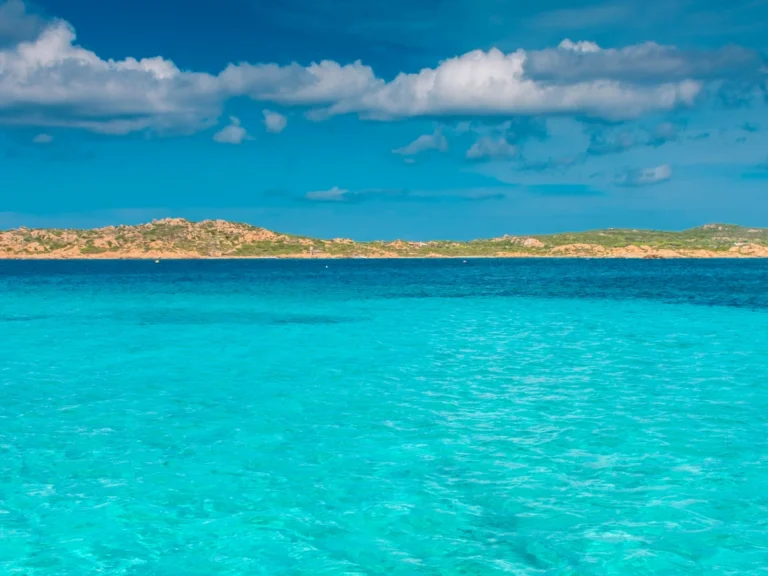
The Natural Pools of Santo Stefano: the Maddalena Archipelago’s best-kept secret (and how to find them)
Did you know there’s a place in the Maddalena Archipelago where the water is so calm and clear that it looks like a swimming pool, surrounded by pink granite rocks sculpted by the water like works of art, and where you can float in total relaxation without a single wave to disturb you? They are known as “The Natural Pools of Santo Stefano”, are located on the island of Santo Stefano, and are one of the best-kept secrets in the entire national park.
In this guide, you will discover:
What exactly are natural pools, and how did they form?
Where are they and why are they so hard to find (and to reach)?
How to get there: only by sea, but with a few precautions
Because they’re better than a swimming pool (and even better than many beaches)
What to bring and what rules to follow to preserve this gem
Reading time: 6 minutes. By the end, you’ll know whether the Santo Stefano Natural Pools are the right destination for you and how to plan your visit (because they’re not for everyone).
What are the Santo Stefano Natural Pools? A masterpiece of nature
The Natural Pools of Santo Stefano are not a beach. They are not a cove. They are something different, rarer and more intimate. They are a series of small freshwater and brackish water pools, carved into the granite by thousands of years of erosion by the wind and the sea, situated on the north-eastern coast of the island of Santo Stefano.
Imagine this: a platform of pink granite jutting out over the sea, as smooth as if it had been polished by a craftsman. On this platform, the sea water, driven by the waves and tides, seeps into natural fissures and crevices. Over time, these fissures widen and deepen, becoming natural pools. At high tide, the water flows in and fills them. At low tide, they remain full thanks to the shape of the rocks, which hold the water back like a natural dam.
The result is open-air pools, fed by the sea but sheltered from the waves. The water is very warm in summer (it heats up in the sun inside the rocks) and incredibly clear. There are no currents, no waves, no dangers. You can sit in one of these pools with the water up to your chest, gaze out at the open sea just a few metres away, and feel as though you’re in a natural spa.
A detail you won’t find anywhere else: Some of these pools contain fresh water. Yes, you heard right. On the island of Santo Stefano, there are small freshwater springs that emerge right where these cracks in the granite are. When it rains, the rainwater collects in the same pools. The result is a unique mixture of fresh and salt water, with a temperature and density different from the surrounding sea. Floating in it is a very strange and wonderful experience: you feel lighter, just like in the Dead Sea, but without the stinging in your eyes.
How many are there? It’s hard to say. There are three main ones – the largest and most accessible. But there are at least a dozen smaller secondary pools, some just a few centimetres deep, others over a metre deep. Every year, with the winter storms, their shape changes slightly. Some pools fill with sand, others become deeper. The Natural Pools are alive; they change and transform.
Where are the Natural Pools? The exact location (and why no one will ever tell you)
This is the trickiest part. The Santo Stefano Natural Pools aren’t signposted. They don’t appear on tourist maps. There’s no sign to mark them. And if you ask the boat tour captains about them, they’ll just smile and say, “I don’t know what you’re talking about.”.
Why? Because it’s an extremely fragile place. There’s no landing place, no beach, no sand. There are only granite rocks and small pools of water. If a hundred people arrived every day, the pools would be destroyed within a week. The locals protect them by keeping quiet.
Having said that, here’s what I can tell you.
The Natural Pools are located on the north-eastern coast of the island of Santo Stefano, about half a kilometre east of Cala Granara, towards the former NATO base. They are situated directly opposite the military jetty. There is no path from the beach: the only way to reach them is by sea, using a small dinghy or a kayak, and then climbing over the rocks.
The approximate coordinates are: latitude 41 degrees 12 minutes north, longitude 9 degrees 25 minutes east. But don’t be fooled: without a marine GPS and without someone who’s been there before, it’s easy to sail right past them without noticing. From the boat, the pools look like mere dark shadows on the rock. You only recognise them once you’re already on top, or when someone points them out to you.
An insider's tip: Instead of searching on your own, ask a local fisherman. Not the dinghy hire operators, not the tour guides. A fisherman. The sort who set out at dawn and return at midday. If you make a good impression on him (and perhaps buy him a coffee), he might give you a tip. Or, even better, ask if he’ll take you there. Some do, under the table. It costs a bit, but it’s worth it.
How do you get to the Natural Pools? Only by sea, and only for experienced swimmers
Getting to the Natural Pools isn’t like going to Cala Granara. It’s more difficult, more technically demanding, and riskier. It’s not suitable for everyone.
With organised boat tour: No organised tour stops at the Natural Pools. There’s no landing stage, no place to moor comfortably, and the stop would be too short to justify the detour. So, if you want to see the Natural Pools, forget about the tours. You’ll have to go on your own.
With a hired dinghy (for experienced users): You can get there by dinghy, but you need to know what you’re doing. There’s no buoy. There’s no jetty. You have to moor on the rocks, using long ropes and a locker, taking care not to damage the hull. The seabed is rocky and uneven. It’s not the place for a beginner.
Here’s what you need to do: approach slowly, with the engine running at very low revs, until you’re just a few metres from the rock. Drop the anchor at the bow and stern so that the dinghy remains parallel to the shore. Don’t pull the dinghy onto the rock: the surf will slam it against the granite and destroy it. Leave it in the water, moored. Then get into the water (watch out for exposed rocks) and swim a few metres to the pools.
By kayak: This is the best way to go about it. A kayak is small, light and easy to manoeuvre right up against the rock. You can tie it to a natural crevice or simply pull it up a few centimetres onto a flat granite ledge. From there, you’re already in the pools. The kayak also allows you to explore every single pool, moving from one to the next without getting out of the water.
Be aware of the tides and the wind. The Natural Pools are only accessible when the sea is calm (waves less than half a metre high) and the wind is light (less than 10 knots). Even a moderate mistral wind makes the waves dangerous for landing. The undertow will throw you against the rocks. Don’t take any risks. If the sea isn’t calm, postpone your trip.
What about the tide? The tidal range at the Strait of Bonifacio is significant (with a difference of up to 50–60 centimetres between high and low tide). The best time to visit the Natural Pools is at high or medium tide. At low tide, the pools empty partially and become shallow. At high tide, however, they are full and overflowing. Check the tide tables before you set off.
Why are natural swimming pools better than artificial ones? (and even better than many beaches)
If you’ve never seen them before, you might think: “What’s so special about puddles in the rock?” You only realise the answer once you’re standing in one.
The water is hot. The granite heats up in the sun. The water in the pools, especially in the afternoon, reaches temperatures of 25–28 degrees. Warmer than the open sea. You step in and relax straight away. There’s none of that initial chill you get when you go into the sea.
There are no waves. Not a ripple. Not even a ripple. The pools are sheltered by the rocks that surround them. The water is as smooth as glass. You can float there in complete relaxation, gaze at the sky, and hear nothing but the sound of the waves breaking just a few metres away from you, yet they never touch you.
The water is crystal-clear. There’s no sand to stir up, no plankton, no cloudiness. The water is so clear that you can see every tiny detail of the granite on the seabed. The pinkish veins, the small shells wedged in the cracks, even the tiny crabs hiding in the crevices.
Privacy. Because it’s hard to get there, because there are no signs, and because tour groups don’t go there, you’ll find very few people at the Natural Pools. Often, there’s no one at all. If you’re lucky, you’ll be on your own. You’ll have a whole corner of paradise all to yourself.
The sensory experience. It’s hard to put into words. You sit in a pink granite tub, the lukewarm water reaching up to your chest; in front of you, the blue sea stretches out to the horizon; behind you, the Mediterranean scrub smells of myrtle and mastic. There is no one else. Just you, the granite, and the water. It is one of the most meditative experiences you can have in the Maddalena Archipelago.
Something you wouldn't expect: Some of the pools are connected by small natural channels. If you lie down in the water, you can crawl from one pool to the next without getting out of the water. It’s like swimming through a water maze.
What are the other natural swimming pools in the Maddalena Archipelago? (And why is Santo Stefano the best?)
Natural pools are not unique to Santo Stefano. There are other similar formations throughout the archipelago. However, the one at Santo Stefano is considered the most beautiful and the most accessible.
On the Island of Spargi: There are small natural pools near Cala Corsara, but they are smaller and are often submerged at high tide. What’s more, Spargi is very popular, so it’s hard to find them empty.
On the island of Santa Maria: Near Cala Santa Maria, there are a few natural pools carved into the rock. However, the water is colder (as it gets less sun) and the seabed is more slippery.
On La Maddalena (the main island): At Punta Tegge, there are some very famous natural pools, but they were “discovered” by tourists years ago. Today, in the high season, they are absolutely packed. And in some places, they have been damaged by visitors walking on them in studded shoes.
Why is Santo Stefano the best? Because it is the most secluded. The difficult access and lack of signposts mean that only the most determined visitors make it there. Furthermore, the granite at Santo Stefano is particularly smooth and sculpted, with almost abstract shapes. And the presence of fresh water makes for a unique experience.
Rules for visiting natural pools (without damaging them)
Natural pools are extremely fragile. More so than a beach, more so than a cove. The granite rock, smoothed by the water, is susceptible to wear and tear. A slipping foot, a studded shoe, a beach umbrella stuck in the sand, a forgotten bottle: any of these can ruin decades of natural formation.
Here are the rules you must follow.
Do not wear studded shoes or shoes with hard soles. Climb the rocks barefoot or in soft-soled rock-climbing shoes (the neoprene ones). Hard soles scratch the granite and leave permanent marks.
Please do not bring parasols, chairs or large towels. There’s no space. There’s no sand. The pools are surrounded by bare rock. You can lay out a towel, but only on a flat rock. Nothing else.
Do not use chemical sun creams before entering. Suncream pollutes the water. Swimming pools are small and enclosed: a single drop of suncream spreads quickly. Use biodegradable suncream or, better still, go in without any protection and reapply it afterwards.
Don’t urinate in swimming pools. It seems like a trivial rule, but many people do it. The water doesn’t circulate as it does in the open sea. It becomes stagnant. A single wee can pollute it for hours.
Please do not bring glass bottles. If they break, the shards will remain in the pools forever. Use aluminium or plastic water bottles.
Please do not move the pebbles or shells. They are part of the ecosystem. Even a a small shell that has been moved changes the flow of water.
Do not enter if the pool is already in use. The pools are small. Two or three people is already quite a lot. If there’s already someone there, wait or come back later. It’s not a public lido.
Take it all away. Even cigarette ends. Even cherry stones. Even sandwich wrappers. Zero waste.
These rules are not optional. They are the only reason the Natural Pools still exist. If everyone followed them, they would remain forever. If anyone breaks them, they will disappear within a few years.
When should you visit the Natural Pools? (calendar and opening hours)
The best time of year is the same as for Cala Granara, with a few key differences.
May and June. Pleasant temperatures. The water is still a bit chilly (18–20 degrees), but it warms up quickly in the pools. Few people around. The sea is often calm. Excellent.
July and August. The water is very warm (24–28 degrees in the pools). But there are also more people. Despite the difficulty in getting there, those in the know still go. The advice is to go early in the morning (8:00–10:00) or late in the afternoon (16:00–18:00). The middle of the day is the busiest.
September and October. The absolute best time of year. The water’s still warm (up to 24 degrees in September). Fewer crowds. Calm seas (September is statistically the least windy month). The sun isn’t too strong. Perfect.
Best time of day: The Natural Pools face east-northeast. They are in the sun from morning until mid-afternoon. The best time for the light is in the morning (9.00–11.00), when the sun shines directly on the water and the rocks. In the late afternoon, the sun is behind the island and the pools are in the shade. Still beautiful, but less photogenic.
Council: Do not go out in strong winds. The natural pools are sheltered, but the wind whips up waves outside them. Landing becomes dangerous. If the forecast predicts winds of more than 15 knots, postpone the trip.
What to bring for a day at the Natural Pools (essential checklist)
The list is shorter than that for Cala Granara, but it has a few specific features.
Water. Plenty. At least two litres per person. There are no drinking fountains.
Packed lunch. Light. No food that leaves crumbs or grease. Simple sandwiches, dried fruit, fresh fruit (with no stones or peel left lying about).
Rock-climbing shoes with soft soles (neoprene). Essential. Granite is sharp. You’ll cut yourself if you’re barefoot. Trainers will scratch the rock. Neoprene rock-climbing shoes are the perfect solution.
Diving mask and fins. Fins are used for swimming from one pool to another without touching the bottom. But be careful: when using fins, take extra care not to damage the pool walls.
Small towel. The one you use to dry yourself. Don’t lay it on the rock unless it’s a flat, smooth surface.
Biodegradable sun cream. Not that kind of chemical. Look for “reef safe” or “biodegradable” on the label. It costs a bit more, but it doesn’t pollute the water.
Waterproof rucksack. If you’re arriving by kayak or dinghy, make sure to keep your phone, keys and documents safe.
A bin bag. Take it all away.
What you should definitely not bring: beach umbrellas (there’s nowhere to put them), chairs (same reason), glass bottles, loudspeakers (silence is sacred), small children who can’t swim (the water is deep and there are no places to hold on to).
Are natural swimming pools suitable for everyone? (To be honest, no)
I have to be honest. Natural swimming pools aren’t for everyone. If you’re looking for a comfortable beach with facilities, sun loungers and parasols, go somewhere else.
They are not suitable for: young children (the water is deep, the rocks are slippery, and there is no lifeguard), people with reduced mobility (to get in, you have to get off a dinghy and climb up smooth rocks), inexperienced swimmers (there are no shallow areas), those seeking comfort (no bar, no facilities, no shade), those afraid of water (the pools are small but deep).
They are suitable for: adults who are strong swimmers, couples looking for romance and privacy, photographers (the morning light is incredible), lovers of nature and tranquillity, and those who have already visited the main beaches and are looking for something different.
A tip: If you’re not confident in your abilities, don’t go. There’s no one there to save you if you slip and hurt yourself. The Natural Pools are a place for experienced swimmers and those in good physical health. There’s no shame in admitting it’s not for you. There are hundreds of other beaches in the archipelago that will give you just as much enjoyment with fewer risks.
Interesting facts about natural swimming pools that you (might) not know
Before I go, here are a few interesting facts that will make your visit (if you ever do go) even more fascinating.
The Pool of Love. The largest of the three main swimming pools has been nicknamed the “pool of love” by local fishermen. Why? Because in the 1960s, during the Cold War, American soldiers stationed at the NATO base in Santo Stefano used to take their girlfriends (and their mistresses) there at the weekends. The pool was a secluded spot, away from the prying eyes of their superiors. It is said that more than one relationship began or ended there.
The secret freshwater. One of the smaller pools, the one closest to the cliff to the east, has a freshwater spring at the bottom. If you dip your hand in and move it around, you can feel the water is cooler there. At certain times of the year, the layer of fresh water remains above the salt water, creating a thin, visible dividing line. This is an extremely rare phenomenon, seen only in the Strait of Bonifacio and in a few other parts of the world.
Starfish. If you look closely at the bottom of some swimming pools, you’ll see tiny starfish clinging to the granite. They’re tiny, and orange or purple in colour. Don’t try to pick them up. They die instantly if they’re taken out of the water.
The missing name. On some old 19th-century maps, these pools were known as “Sa Covecca de is Piscinas”, which in Sardinian means “the pool’s cove”. Nobody calls them that anymore. The name has been lost. But the old fishermen still remember it.
A film set that never was. In the 1970s, an Italian film director wanted to shoot a scene for a film at the Natural Pools. The scene involved a nude actress floating in the water. However, the National Park (which had not yet been officially established at the time, but was already under supervision) refused permission. The film was shot elsewhere. No one knows which film it was.
Conclusion: Natural Pools, a treasure to be protected
The Natural Pools of Santo Stefano are not a tourist destination. They don’t feature on postcards. They aren’t in travel brochures. They are a secret, hidden, fragile place that few people know about and very few visit. And perhaps that’s for the best.
Because their beauty lies precisely in their inaccessibility. It lies in the effort you have to make to get there. It lies in the search, in the discovery, in the silence you find when you’re finally there, with the warm water enveloping you and the blue sea stretching out before you.
If you decide to seek them out, do so with respect. Take only what you need. Leave no trace of your visit. Don’t tell everyone where they are. Protect them as you would a precious secret. Because natural pools are not a right. They are a privilege. And privileges must be earned through respect.
Next time you’re in the Maddalena Archipelago, whether you’re out in a dinghy or a kayak, take a closer look at the north-eastern coast of Santo Stefano. Look for the dark shadows on the rocks. Listen to the fishermen’s advice. And if you find them, if you manage to enter those magical waters, you’ll understand why those who discovered them never speak of them.